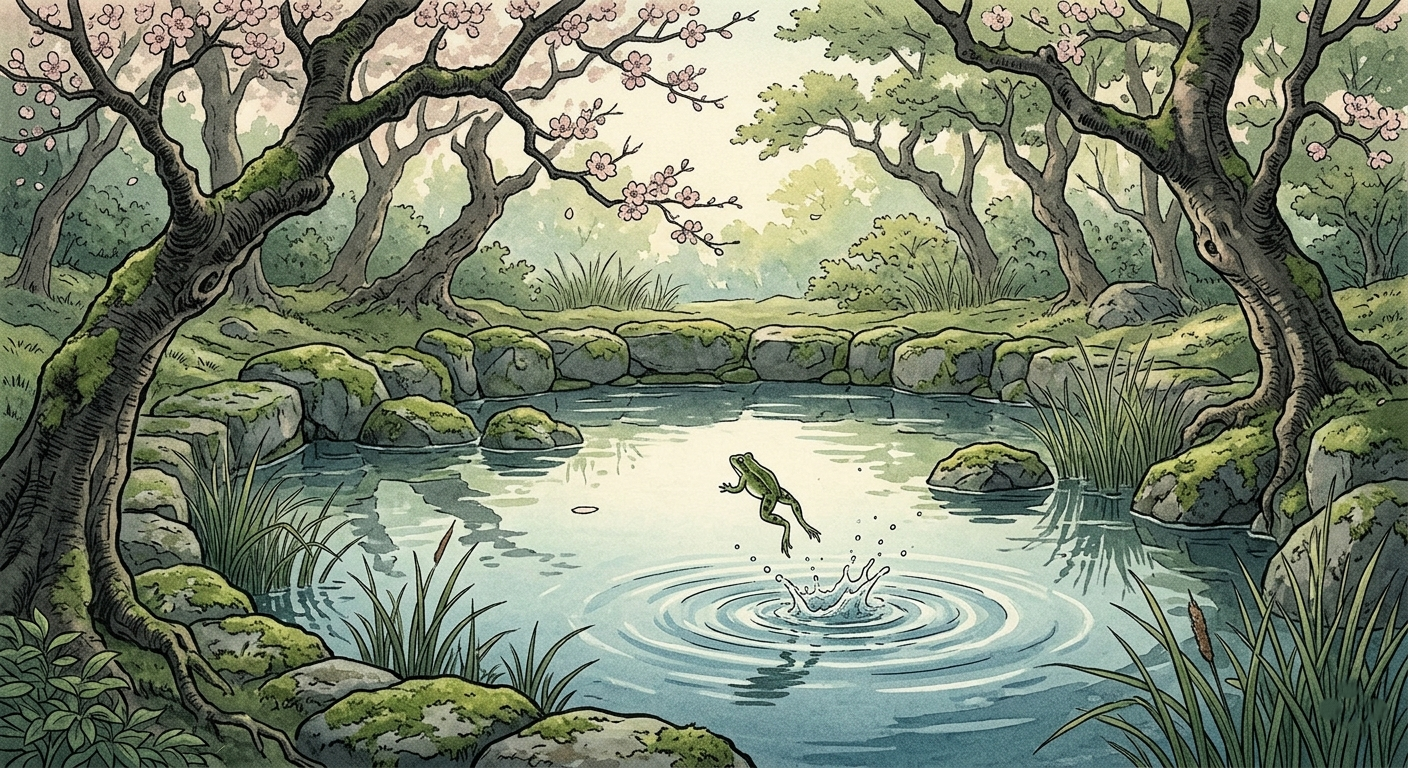

A haiku is a traditional form of Japanese poetry renowned for its simplicity, discipline, and deep connection to nature. It consists of exactly 17 syllables arranged in a strict three-line pattern of 5, 7, and 5 syllables. Traditionally, a haiku focuses on a brief, fleeting moment in time, often capturing a vivid sensory image or a sudden realization. A classic haiku also includes a kigo (a seasonal word, like “cherry blossoms” or “snow”) to anchor the poem in a specific time of year, and a kireji (a “cutting word” or structural pause) that creates a subtle contrast or shift in perspective between the lines.
When translated into English or written by modern poets, the rigid 5-7-5 syllable structure is sometimes relaxed to better fit the rhythm of the English language, but the core essence remains the same: saying a lot with very few words. Rather than using complex metaphors or rhyming schemes, a great haiku acts like a snapshot, painting a picture that allows the reader to feel the quiet beauty of the world. It invites us to slow down, notice the small details of our surroundings, and appreciate the present moment.
Here are Classic and modern examples; a few beautiful examples of haiku, including a famous classic by the master Matsuo Basho:
The Old Pond (by Matsuo Bashō)
An old silent pond… (5 syllables)
A frog jumps into the pond, (7 syllables)
splash! Silence again. (5 syllables)
Summer Breeze (Modern)
Line of gentle warmth, (5 syllables)
Dancing through the open door, (7 syllables)
Whispering of peace. (5 syllables)
Winter Morning (Modern)
Crisp and frozen air, (5 syllables)
White snow blankets all the trees, (7 syllables)
Nature falls asleep. (5 syllables)
