Poetry
A very brief introduction of poetry, including Haiku
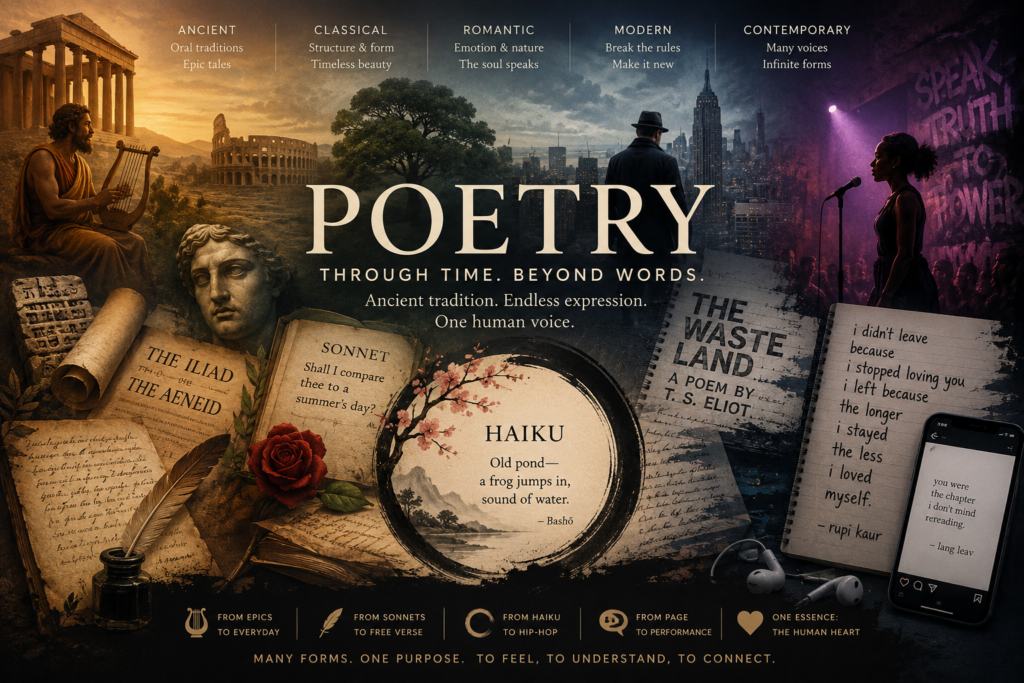
Poetry are of two types in general; of course, it comes with different types, rhyming schemes, vers libre, and modern and contemporary short poems, which are like a brief quote, popularised mostly by Rupi Kaur, Lang Leav, etc. The two major divisions broadly speaking are Haiku and these abovementioned different types
Poetry, at its ancient core, began not as words on a page, but as a living, breathing oral tradition designed to be sung or chanted. In the Classical Age, civilizations like ancient Greece and Rome viewed poetry as a divine craft, heavily bound by strict structures, meters, and musicality. Epics like Homer’s Iliad or Virgil’s Aeneid were not just entertainment; they were the cultural repositories of history, myth, and civic virtue. To the ancients, poetry was an act of preservation, utilizing rigid rhythmic patterns like dactylic hexameter as mnemonic tools to ensure that the tales of gods and heroes could be memorized and passed down flawlessly through generations.
As Europe transitioned into the Medieval and Renaissance periods, poetry shifted from the grand, public stages of marketplace recitations into the courts and private studies of the literate elite. While the religious devotion of the Middle Ages birthed sweeping allegorical journeys like Dante’s Divine Comedy, the Renaissance sparked a massive revival of classical humanism. Poets became obsessed with intricate, highly structured forms, most notably the sonnet. Figures like William Shakespeare and Francesco Petrarch used these demanding fourteen-line frameworks to dissect the complexities of human love, mortality, and time, proving that immense emotional depth could be engineered within strict, mathematical constraints of rhyme and meter.
The late eighteenth and nineteenth centuries brought a passionate rebellion against the rigid, hyper-rational rules of the Enlightenment, ushering in the Romantic and Victorian eras. Thinkers like William Wordsworth and John Keats redefined poetry as the spontaneous overflow of powerful feelings, shifting the focus from external rules to internal landscapes. Poetry became deeply intertwined with the sublimity of nature, individual subjectivity, and the melancholy of a rapidly industrializing world. The form began to loosen, giving way to more fluid expressions like blank verse, as poets sought a language that felt closer to the authentic human soul rather than the elite academic institutions of the past.
By the dawn of the twentieth century, the cataclysm of World War I and the dizzying pace of modernization shattered traditional worldviews, forcing poetry to reinvent itself entirely. Modernism emerged with a fierce battle cry to “make it new,” led by iconoclasts like T.S. Eliot and Ezra Pound. They rejected the neat, comforting rhymes of the past, viewing them as inadequate for expressing the fragmentation, anxiety, and alienation of modern urban life. Poetry became a complex mosaic of free verse, stream-of-consciousness, and striking imagery, deliberately challenging the reader to find meaning in a world that felt increasingly broken and chaotic.
In the mid-to-late twentieth century, the lens of poetry turned sharply inward and outward simultaneously through the Postmodern and Confessional movements. Writers like Sylvia Plath, Allen Ginsberg, and Maya Angelou stripped away the dense, intellectual armor of early Modernism to write with raw, sometimes jarring honesty about personal trauma, mental health, race, and sexuality. At the same time, poetry became a vital weapon for political activism and social justice. The definition of what was considered “poetic” expanded dramatically to include the vernacular of the streets, jazz rhythms, and the lived experiences of marginalized communities, democratizing the art form like never before.
Today, in the digital and multimedia landscape of the contemporary era, poetry has broken completely free from the confines of traditional publishing. It thrives across a sprawling spectrum that includes spoken word slams, hip-hop lyricism, and visual “Instapoetry” designed for rapid consumption on social media. Modern poetry is characterized by a radical lack of rules, blending classical forms with casual internet slang, and traditional imagery with digital aesthetics. Yet, despite these radical shifts in medium and style over thousands of years, the fundamental essence of poetry remains completely unchanged: it is the human drive to condense the vast, messy infinity of experience into a handful of unforgettable words.