
One thing that must be pondered about the Chief Minister Khemchand’s visit is that it is seen by many as far more than a simple visit. For them, it symbolises the crossing of the buffer zone and the invitation of an opposing side into contested territory before peace, reconciliation, or a political settlement has been achieved. This is why the event has attracted intense criticism. To dismiss it as merely a visit is to overlook its broader political significance. Those involved are not ordinary individuals; they are political leaders whose presence, movements, and public actions inevitably communicate political messages. In politics, symbolism carries weight. Their presence speaks, their decisions speak, and their movements speak. Whether one agrees with these interpretations or not, many believe that the event represents much more than a ceremonial appearance.
One of the deepest challenges facing our society is that collective political aspirations are too often reduced to immediate material gains. A long-standing struggle that concerns identity, dignity, land, rights, and the future of an entire people is frequently narrowed to what may be called Langva politics. Langva—the roofing material commonly distributed under government housing schemes—has become a symbol of transactional politics in many remote villages of Northeast India, including the margins of Manipur. For many communities that have long experienced poverty and neglect, receiving a few sheets of roofing material, a road repair, or another small benefit can appear to be the fulfilment of political responsibility. In such circumstances, the larger purpose of politics is forgotten. Politics ceases to be about protecting a people’s future and instead becomes a means of distributing short-term favours. The tragedy is not that people value these necessities—they genuinely need them—but that generations of neglect have conditioned them to believe that such temporary assistance is the highest achievement politics can offer.
Closely related to this is the transformation of political leadership into electoral ambition. What was once a collective political aspiration of the people has increasingly been reduced to the personal ambition of becoming a so-called legislator. Rather than serving as representatives of a broader national or communal vision, many political actors treat public movements as stepping stones for their own careers. The language of sacrifice, justice, and self-determination is often employed only until an election approaches. Thereafter, the struggle itself becomes secondary to securing party tickets, political alliances, and legislative seats. The people’s long-standing aspirations are gradually redefined to fit electoral calculations. Instead of asking what political future best serves the community, discussions revolve around who will become the next MLA. In this way, the original political vision is diluted until the office itself becomes the goal, rather than the instrument through which meaningful change could be pursued.
Equally damaging is the tendency of individuals to exploit public political issues for private gain. Many people participate passionately in political causes only as long as there is a personal benefit to be obtained. Once they receive employment, contracts, financial assistance, appointments, or other advantages, their commitment often fades. The collective struggle loses momentum because individual interests have been satisfied. Public causes become bargaining tools rather than enduring commitments. This creates a cycle in which every political movement can be weakened simply by rewarding a few influential individuals. The intensity of public resistance, no matter how genuine at first, gradually declines until it reaches silence. A people who once stood together become fragmented into individuals pursuing separate benefits.
This pattern reveals a deeper crisis—not merely of leadership, but of political consciousness. A society cannot sustain a meaningful political future if its collective aspirations are continually exchanged for temporary material benefits, personal ambition, or individual advantage. Political maturity requires the ability to distinguish between necessities that improve daily life and principles that determine the future existence of a people. Roads, houses, roofing materials, welfare schemes, and elected offices all have their place, but they should never replace the larger political questions concerning identity, justice, representation, and the long-term well-being of the community. Unless the people recover this distinction, every generation risks inheriting the same unresolved struggles while believing they have already been solved by temporary comforts and electoral victories.
Langva Politics represents more than the distribution of roofing sheets or other welfare benefits; it symbolizes a political culture that reduces a people’s long-term aspirations to short-term material gratification. When politics becomes centered on immediate personal benefits rather than collective rights and political vision, the public gradually loses sight of the larger questions that determine its future. A people who once aspired to justice, dignity, security, and political recognition begin measuring leadership by the number of schemes, subsidies, or favours they receive. Such a transformation weakens the very foundation of public political consciousness.
The greatest danger of “Langva Politics” is that it fragments collective aspirations into individual interests. Instead of asking what is best for the community as a whole, people begin asking what they themselves can gain. Public movements lose their unity because individuals become satisfied with personal rewards. As long as temporary needs are met, many become indifferent to unresolved structural and political issues. This creates a society that is easily managed through patronage rather than inspired by shared principles.
Moreover, Langva Politics benefits those who seek to preserve the status quo. When the public is occupied with competing for welfare schemes, contracts, or electoral promises, fundamental political questions are pushed into the background. Leaders no longer need to address historical grievances, constitutional rights, justice, or long-term development. Instead, they can maintain public support through periodic distribution of benefits while leaving deeper problems unresolved. In this way, material dependency gradually replaces political empowerment.
A people’s aspiration cannot flourish where political imagination has been reduced to transactional exchange. Every society requires development, welfare, and public assistance, but these should strengthen the people rather than silence their collective voice. When temporary benefits become substitutes for political vision, the struggle for a secure and dignified future is slowly eroded. Langva politics therefore does not merely distract from public aspiration—it has the potential to weaken, delay, and ultimately undermine it by replacing enduring principles with fleeting material satisfaction. Your framework can be strengthened by making it less about the individuals in the photograph and more about the different levels of political consciousness that the event revealed. That makes the argument more analytical and avoids attributing motives that cannot be verified.
Three Levels of Political Consciousness
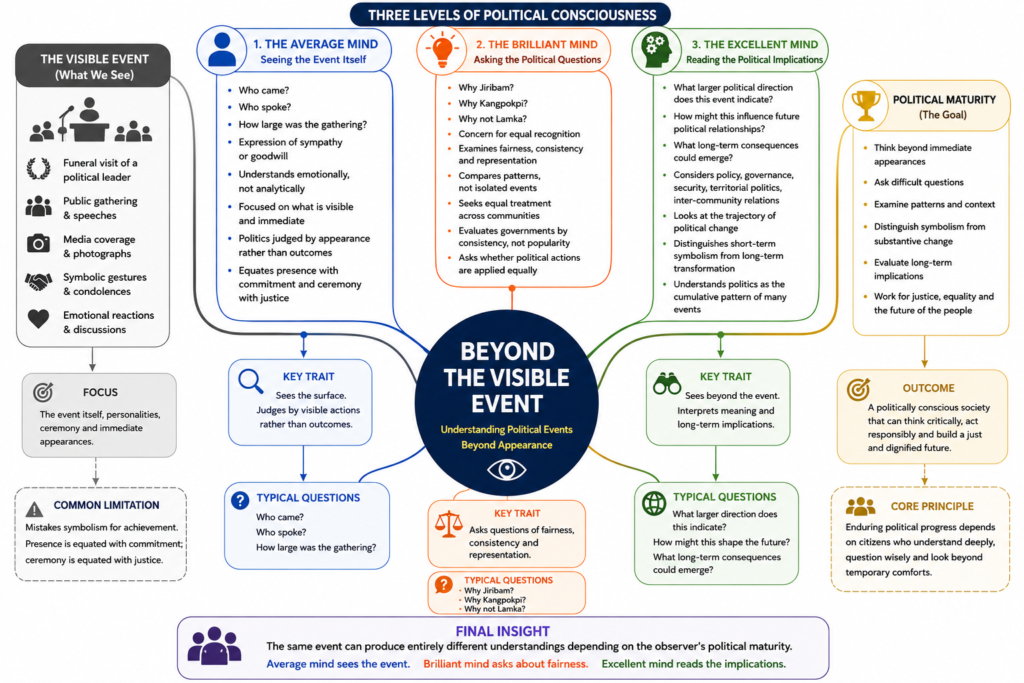
The visit of Chief Minister Khemchand to the funeral of Vungzagin Valte became far more than a ceremonial appearance. It served as a mirror reflecting the different levels of political consciousness that exist within society. The event itself remained the same, yet the interpretations varied significantly depending on the observer’s depth of political understanding. Some saw only the visible ceremony; others questioned its fairness, while a few attempted to understand its broader political implications. These varying responses demonstrate that political consciousness is not determined by education alone but by one’s ability to distinguish between appearance, fairness, and long-term political consequences.
1. The Average Mind: Seeing the Event Itself
The average observer tends to interpret politics through what is immediately visible. The attention of such a mind is naturally drawn toward personalities, speeches, public gatherings, media coverage, and symbolic gestures. The presence of high-ranking political leaders itself becomes the central story. The event is understood primarily as an expression of sympathy, respect, or goodwill. At this level, politics is interpreted emotionally rather than analytically. The observer asks simple questions such as: Who came? Who spoke? How large was the gathering? These observations are not necessarily wrong, but they remain confined to the surface of political events. Little attention is paid to why the event occurred in a particular way, what political messages were communicated, or what consequences might follow.
Consequently, political symbolism is often mistaken for political achievement. A visit, a speech, a handshake, or a public appearance may be celebrated as though it has resolved deeper structural issues. The average mind judges politics by visible actions rather than by measurable outcomes. It tends to equate presence with commitment and ceremony with justice. This level of consciousness is common because immediate appearances are naturally easier to understand than complex political realities. However, remaining at this level leaves the public vulnerable to symbolic politics, where carefully staged gestures replace substantive political solutions.
2. The Brilliant Mind: Asking the Political Questions
A more developed political consciousness refuses to stop at appearances. Instead, it begins asking questions of fairness, consistency, and representation. Rather than celebrating or condemning an event immediately, the brilliant mind examines why similar political actions occur in one place but not in another. From this perspective, several legitimate questions naturally emerge:
- Why Jiribam?
- Why Kangpokpi?
- Why not Lamka?
These questions are not expressions of hostility or regional competition. Rather, they reflect a concern for equal political recognition. They seek to understand whether public institutions are treating communities with fairness and consistency. The fair mind recognizes that official visits, public ceremonies, and symbolic gestures communicate political messages. Every decision about where political leaders go—or where they do not go—can shape public perception regarding whose suffering receives attention and whose does not.
Unlike the average observer, the fair-minded individual compares patterns instead of isolated events. The concern shifts from what happened to why similar situations receive different political responses. Fairness becomes the central principle guiding political evaluation. This level of political consciousness strengthens democratic accountability because it encourages citizens to evaluate governments according to consistency rather than popularity. Instead of accepting every public gesture at face value, the fair mind asks whether political actions are applied equally across communities.
3. The Excellent Mind: Reading the Political Implications
The highest level of political consciousness seeks not merely to understand events but to interpret their wider political significance. It recognises that individual events rarely exist in isolation; rather, they often form part of broader political processes unfolding over time. The excellent mind therefore asks questions that move beyond fairness:
- What larger political direction does this event indicate?
- How might this influence future political relationships?
- What long-term consequences could emerge from today’s symbolic actions?
Instead of viewing the visit solely as a funeral attendance, this perspective considers how it may interact with wider issues such as administrative policy, inter-community relations, territorial politics, security arrangements, and the gradual evolution of governance in conflict-affected regions. From this perspective, discussions surrounding matters such as the buffer zone, territorial administration, political messaging, and changing patterns of state engagement become subjects of careful analysis. Whether one ultimately agrees with a particular interpretation or not, the excellent mind understands that political events often carry meanings beyond their immediate purpose.
This level of consciousness is characterized by strategic thinking rather than emotional reaction. It distinguishes between short-term symbolism and long-term political transformation. It recognizes that seemingly isolated events may gradually reshape public perception, alter political expectations, or influence future policy decisions. Most importantly, the excellent mind understands that politics is rarely defined by a single event. It is the cumulative pattern of many events that reveals the true direction of political change.
3. The Excellent Mind: Reading the Political Implications
The highest level of political consciousness seeks to understand not only what happened, but what the event may signify within a broader political process. It examines the possible implications behind public actions, asking how individual events relate to larger political developments. From this perspective, the event may be interpreted as part of a wider political environment in which the dynamics surrounding the buffer zone, territorial administration, and inter-community relations are gradually evolving. Whether one agrees with such interpretations or not, this level of analysis focuses on the long-term political consequences rather than the immediate ceremony itself. This approach does not stop at asking what happened; it asks what direction the political landscape may be moving toward.
Perhaps the most revealing aspect of the event was not the government’s actions alone, but the public’s response. Much of the discussion, celebration, criticism, and interpretation arose from the people themselves. Public opinion is often shaped not only by official decisions but also by persuasion, expectation, political narratives, and collective perception. Governments may influence these narratives, but ultimately it is society that gives them meaning. The true measure of political consciousness, therefore, lies not in how loudly people react to an event, but in how deeply they are able to understand its broader implications and distinguish symbolism from substantive political change.
These three levels of political consciousness illustrate that the same event can produce entirely different understandings depending on the observer’s political maturity. The average mind sees the event itself. The brilliant mind asks whether the event reflects justice and equal treatment by pointing out the fairness of the political process. The excellent mind examines where the event may lead and what broader political processes it represents. A politically conscious society should aspire to move beyond immediate appearances without abandoning fairness. Symbolic politics has its place, but enduring political progress depends upon citizens who can think critically, ask difficult questions, and carefully evaluate the long-term implications of public events. Thus, political maturity is measured not by how quickly people react to events, but by how deeply they understand the forces shaping their collective future.