
A wiki for Pu Vungzagin Valte:
The tragic case of Vungzagin Valte has become a powerful symbol of the political reality confronting the people. During the tenure of former Chief Minister Biren Singh, Valte was brutally attacked after the outbreak of violence in Manipur, suffering life-altering injuries that he never fully recovered from. His eventual passing represents, for many, not merely the death of an individual but the culmination of a prolonged political tragedy.
The transition of power from one Chief Minister to another does little to erase that history. If one Chief Minister presided over the circumstances that led to Valte’s suffering, the arrival of the new Chief Minister, Khemchand, at his funeral carries a profound symbolism. It reminds us that changing political faces does not automatically bring justice, accountability, or healing. A funeral attended by those in power cannot substitute for answers, responsibility, or meaningful political resolution.
The image is therefore deeply symbolic: one administration became associated with the violence and suffering, while another stood beside the grave. Between these two moments lies the story of a people whose wounds remain unresolved. The funeral should not become the final chapter of public memory. Rather, it should stand as a reminder that genuine political leadership is measured not by ceremonial appearances after a tragedy but by the willingness to prevent such tragedies, seek justice, and restore the dignity of those who have suffered.
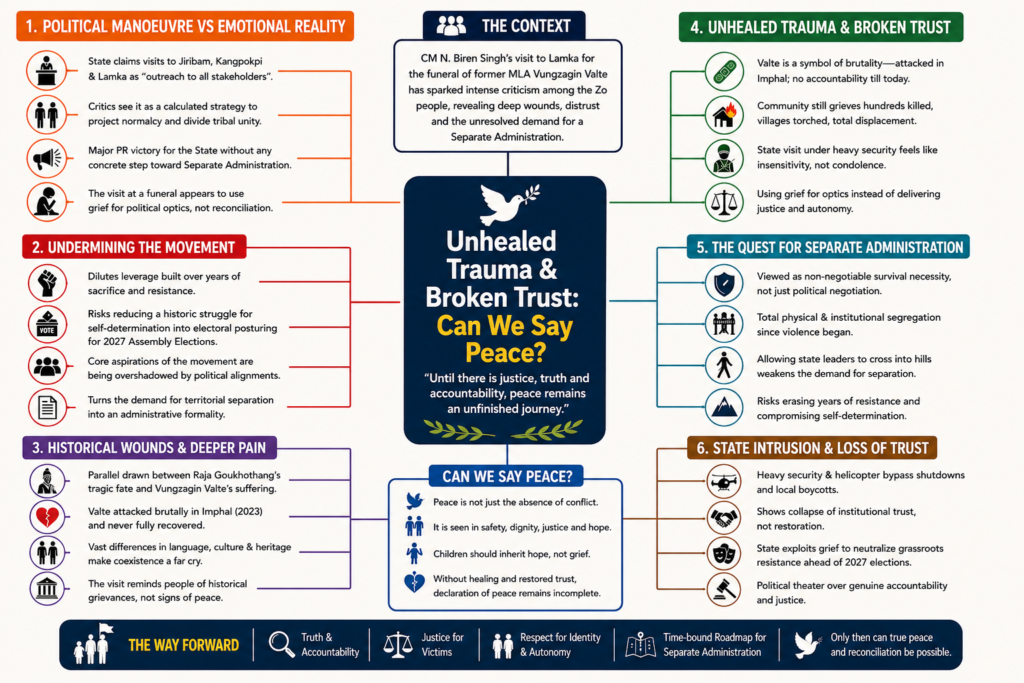
The visit of Chief Minister Khemchand to Lamka for the funeral of former MLA Vungzagin Valte has ignited sharp criticism, exposing the deep divide between state political maneuvers and the emotional reality of the Zo people. While the administration frames his visits across Jiribam, Kangpokpi, and Lamka as a comprehensive outreach to all stakeholders, critics view it as a calculated strategy to project an illusion of normalcy and fracture tribal unity. For many, allowing the Meitei Chief Minister onto hill territory offers the state a major public relations victory without yielding any concrete progress toward the grassroots demand for a Separate Administration.
There is a profound fear that the core aspirations of the movement are being cheapened and overshadowed by political alignments ahead of the 2027 Manipur Assembly Elections. Critics argue that accepting this symbolic visit dilutes the leverage built over years of sacrifice, threatening to reduce a historic struggle for territorial separation into mere electoral posturing. The timing of the visit at a funeral only intensifies this grievance, making it appear as though the community’s grief is being utilised for political optics rather than genuine reconciliation.
This tension is further exacerbated by deep historical wounds, specifically the evocative parallel drawn between the tragic fate of 19th-century leader Raja Goukhothang and the suffering of Vungzagin Valte, who never recovered after being brutally attacked in Imphal in 2023. In the eyes of many critics, the vast differences in language, culture, and heritage between the Zo and Meitei civilisations make administrative coexistence a far cry. To them, the visit does not signal peace but rather a painful reminder of historical grievances where political gestures ultimately fail to address the fundamental demands for justice and autonomy.
At the heart of the outrage lies the conviction that this visit fundamentally undermines the hard-fought movement for a Separate Administration. For over three years, the total physical and political segregation between the valley and the hills has been treated by the Zo people not merely as a political agenda, but as a non-negotiable survival necessity. Critics argue that allowing the head of the Imphal-based government to bypass this geopolitical border—even under the guise of funeral condolences—dilutes the community’s leverage and compromises the sacredness of their territorial demand. To many, it signals an implicit, dangerous acceptance of the status quo, threatening to erase years of resistance and reduce a historic struggle for self-determination into an administrative formality easily managed by state authorities.
Furthermore, the visit forces a painful confrontation with unhealed trauma and unresolved grievances. The late Vungzagin Valte was not just a politician; he was a living testament to the brutality of the conflict, having spent his final years permanently incapacitated by a vicious mob attack in the state capital—a crime for which no one has been held accountable. For the Chief Minister to step onto the soil of Lamka while the community is still grieving hundreds of lives lost, villages torched, and total displacement feels to critics like an act of profound insensitivity. By choosing this moment of vulnerability to project an image of “dialogue” and “reconciliation,” the state government is seen as weaponizing the community’s grief, offering superficial political optics in place of the systemic justice and structural autonomy the people actually demand.
Ultimately, this intrusion deepens the collective trauma by signaling that the state values political theater over genuine accountability. For a community that has institutionalized its mourning and anchored its future on the absolute necessity of separation, the presence of an Imphal authority at Valte’s casket feels less like a gesture of respect and more like an aggressive assertion of continuous state dominance. It shatters the psychological safety the hills have tried to build away from the valley. Critics argue that instead of paving a path toward peace, such maneuvers only serve to validate the people’s deepest fears: that their suffering is being neutralized by the state, and that the long-sought goal of a separate administrative identity is being quietly bartered away for political convenience.
For the Zo people, the pursuit of Separate Administration is far more than a political negotiation or a reaction to governance failure; it is viewed as a foundational act of self-preservation. Having experienced total physical and institutional segregation since the outbreak of violence, the hill communities have reconstructed their entire lives around the premise that coexistence with the valley-based government is permanently broken. Critics argue that allowing the state’s highest executive authority to breach this strictly enforced geopolitical and psychological boundary completely disregards the sacrifices made by the community. By treating the district borders as porous for state PR exercises, the visit threatens to trivialize the demand for a distinct Union Territory or legislative separation, reducing a historic struggle for survival into a routine administrative jurisdiction.
This political encroachment deepens an already profound collective trauma by forcing the community to witness state authorities controlling the narrative around their losses. The late Vungzagin Valte’s slow, agonizing decline following the horrific 2023 assault in Imphal stands as a visceral symbol of the vulnerability tribal leaders faced in the capital. To have the state leadership arrive via helicopter, bypassing local boycotts and intense shutdowns under a massive security blanket, feels to critics less like an act of genuine condolence and more like an aggressive display of continuous state dominance. By turning a solemn, community-wide mourning into a highly secured political event, the state is seen as overriding the people’s grief, reinforcing the painful reality that genuine accountability and systemic justice remain entirely unaddressed.
The state government’s tactical decision to send its highest executive leadership into the hills—relying on heavy security cordons and aerial transport—unwittingly underscores the absolute collapse of institutional trust rather than its restoration. By treating district lines as porous borders that can be briefly crossed for high-profile public relations events, the administration attempts to project an illusion of geographical integration to the central government. For the local population, however, this forced proximity does not bridge the chasm; it violently reminds them of it. The presence of an Imphal authority at the casket of a leader who was systematically broken in the capital city represents an aggressive assertion of continuous state dominance over a community that has spent years physically and psychologically insulating itself from the valley.
Furthermore, this intervention directly targets and seeks to fragment the collective bargaining power of the tribal movement. By systematically organizing distinct, localised visits to different leadership factions across Jiribam, Kangpokpi, and Lamka, the state plays a sophisticated game of political segmentation. Critics see this as a deliberate attempt to dilute the unified, non-negotiable demand for a Separate Administration into small-scale, localized concessions. The strategic arrival of the state apparatus during a moment of intense community vulnerability and mourning is viewed not as a gesture of genuine condolence, but as a calculated exploitation of grief designed to neutralize grassroots resistance and secure electoral stability ahead of the 2027 Manipur Assembly elections.
Thus, this political intrusion deepens a historical trauma that has been restitched into the fabric of the current crisis. To the Zo people, the agonizing trajectory of Vungzagin Valte is not an isolated political casualty; it is a modern-day recurrence of historical treachery, a direct parallel to the systemic injustices that have historically defined their relationship with valley-based rulers. By prioritizing political theater and superficial optics over the fundamental, time-bound demands for accountability, justice, and legal territorial separation, the state administration proves that it is entirely disconnected from the emotional reality on the ground. Instead of offering a pathway toward genuine healing, these calculated maneuvers only solidify the conviction that peaceful coexistence within the existing administrative framework remains a far cry.
The sight of the children of Vungzagin gathered in Lamka today was more than a remembrance; it was a reminder that violence does not end when the gunfire stops. The deepest wounds are often carried by those who inherit the memories of loss. For many families, trauma remains unhealed, and trust—once broken—is difficult to restore. While peace is often proclaimed through political statements and ceasefire agreements, genuine peace demands justice, truth, accountability, and the assurance that such tragedies will never be repeated.
Peace cannot be measured merely by the absence of conflict. It is reflected in whether survivors and the next generation can live without fear, whether communities feel secure in their homes, and whether children inherit hope instead of grief. Until these questions are honestly addressed, commemorations such as today’s serve not only as acts of remembrance but also as poignant reminders that reconciliation is an unfinished journey. Without healing and restored trust, the declaration of peace remains incomplete.