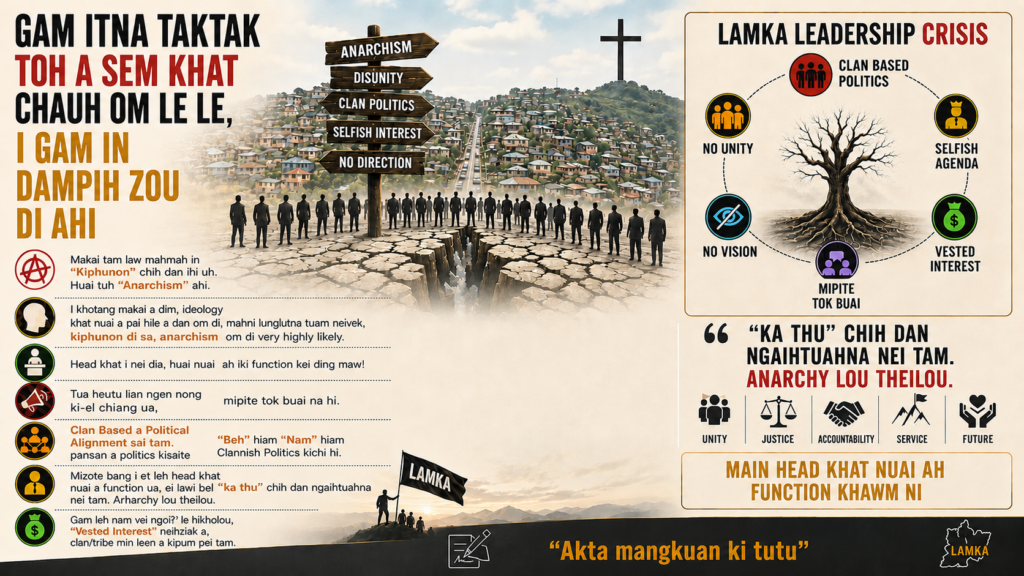

Politics plays a significant role in shaping the future of every society. It determines how people are governed, how resources are distributed, and how communities work together toward common goals. In Lamka, politics has become an important topic of discussion because many people believe that the community is facing a leadership crisis. Instead of promoting unity and collective progress, political competition has often been characterised by clan loyalty, personal interests, and the absence of a shared vision. As a result, distrust, division, and confusion have become increasingly common. For Lamka to progress, its people must reflect on the current political situation and work toward a system built on unity, accountability, justice, and service rather than personal gain.
One of the most serious challenges facing Lamka politics is the rise of clan-based politics in the past three to four decades. Ideally, political leaders should be chosen based on their integrity, competence, experience, and commitment to serving the people. However, when political support is determined primarily by clan, tribe or family ties, merit and excellence are often ignored. This weakens democratic values because voters begin to prioritise kinship over leadership qualities. Leaders who depend mainly on clan support may feel accountable only to their own group instead of the entire community. Thus, decisions that should benefit everyone may instead favour a particular section of society. Such practices gradually erode trust among different communities and create unnecessary divisions.
Closely related to clan politics is the problem of disunity. A society divided into competing groups struggles to pursue common goals. Instead of cooperating for the welfare of Lamka, different factions often compete against one another, viewing politics as a contest between “us” and “them”. This mentality discourages collaboration and prevents meaningful development. Roads, schools, healthcare, employment opportunities, and other public needs become secondary to political rivalries. When people stop seeing themselves as members of one community, progress becomes difficult because collective action is replaced by constant disagreement.
Another challenge is the growth of selfish agendas among some political actors. Politics should fundamentally be about serving the people. Public office is a responsibility rather than a privilege. Unfortunately, when leaders seek political power mainly for personal benefit, they lose sight of the needs of ordinary citizens. Personal ambition, prestige, financial gain, or influence may become more important than public welfare. Such leadership often results in poor governance, lack of transparency, and declining public confidence. Citizens become frustrated when promises are not fulfilled and when leaders appear more interested in protecting their own positions than solving community problems.
Alongside selfish agendas are vested interests, where decisions are influenced by hidden personal or group benefits rather than the common good. Vested interests often prevent fair policymaking because leaders may prioritise individuals or groups that support them politically. Resources may be distributed unequally, opportunities may become limited, and public trust begins to disappear. When people believe that decisions are motivated by favouritism rather than justice, confidence in democratic institutions weakens. A healthy political system requires leaders who are willing to place the interests of the whole community above their own.
The combination of clan politics, selfish agendas, and vested interests often leads to a lack of direction. Every successful society requires a clear vision for its future. Political leadership should identify long-term goals such as improving education, strengthening healthcare, encouraging economic growth, protecting cultural heritage, and creating opportunities for young people. However, when politics becomes consumed by personal rivalries and short-term calculations, long-term planning is neglected. Leaders spend more time responding to political conflicts than addressing the real needs of society. As a result, development becomes slow, inconsistent, and fragmented.
The absence of a shared vision also creates confusion among the people. Citizens become uncertain about whom to trust, which direction society is heading, and whether political leaders genuinely represent their interests. Young people, in particular, may become disillusioned with politics altogether. Instead of viewing politics as a means of public service, they may see it as a field dominated by conflict and self-interest. This confusion weakens civic participation because people lose faith in the political process itself. A society cannot thrive if its citizens no longer believe that leadership exists to serve them.
These problems collectively contribute to what many describe as a leadership crisis. Leadership is not simply about holding authority or occupying high positions. True leadership requires wisdom, integrity, humility, courage, and a willingness to place community interests above personal ambitions. A leader must unite people rather than divide them. In times of disagreement, effective leaders seek dialogue and reconciliation rather than confrontation. They inspire confidence through honesty and fairness, not through fear or favouritism. When these qualities are absent, leadership loses its moral authority, and society experiences uncertainty and instability.
The poster’s reference to anarchy serves as a warning rather than a prediction. Anarchy does not necessarily mean the complete absence of government; it can also refer to a situation where authority becomes ineffective because society no longer respects common rules or shared leadership. When political divisions become too deep, institutions weaken, cooperation declines, and public confidence deteriorates. Without effective leadership, even well-designed systems struggle to function. Therefore, preventing political disorder requires strengthening legitimate leadership built upon public trust and collective responsibility.
An important solution to these challenges is unity. Unity does not mean that everyone must agree on every issue or belong to the same political party. Healthy democracies naturally include different opinions and competing ideas. However, unity means recognising that despite political differences, all citizens share a common future. Political disagreements should never destroy the bonds that hold society together. Respectful dialogue, mutual understanding, and cooperation are essential for maintaining social harmony. Leaders should encourage inclusiveness by representing every section of society fairly, regardless of clan, family, or political affiliation.
Equally important is justice. Justice ensures that every citizen is treated fairly under the law and that opportunities are distributed without discrimination. A just political system does not reward individuals based on personal connections but based on fairness and equality. Justice strengthens public trust because citizens know that their rights will be protected regardless of their social background. When justice becomes a guiding principle, political competition becomes healthier since people compete based on ideas, competence, and service rather than favoritism.
Another essential principle is accountability. Leaders should always remain answerable to the people they serve. Accountability requires transparency in decision-making, responsible use of public resources, and openness to criticism. Citizens also have responsibilities: they must participate actively in elections, ask questions, monitor government performance, and encourage ethical leadership. Democracy functions effectively only when both leaders and citizens fulfil their respective responsibilities. Accountability discourages corruption and helps ensure that political authority is exercised responsibly.
Politics must also be guided by service. Public office exists to improve the lives of ordinary people. Leaders who genuinely serve their communities focus on practical issues such as education, healthcare, employment, infrastructure, environmental protection, and social welfare. They spend less time engaging in political conflicts and more time solving real problems. Service-orientated leadership inspires confidence because citizens can see tangible improvements in their daily lives. Such leadership earns respect not through speeches alone but through consistent action.
Young people have a particularly important role in transforming Lamka politics. They represent the future generation of leaders, professionals, educators, entrepreneurs, and community builders. Rather than inheriting political divisions, young people should cultivate values of critical thinking, ethical leadership, cooperation, and civic responsibility. Education plays a crucial role in developing these qualities. Schools, colleges, churches, civil society organisations, and families should encourage youth to value competence, honesty, and public service above narrow identity politics. By participating constructively in public life, young citizens can gradually reshape the political culture of Lamka.
Civil society and religious institutions can also contribute positively by promoting dialogue, reconciliation, and community service. They provide spaces where people from different backgrounds can work together despite political differences. Instead of reinforcing divisions, community organisations should encourage shared responsibility for the common good. Public discussions should focus on solving problems rather than attacking opponents. Respectful disagreement is a strength of democracy, but hostility and hatred only deepen existing divisions.
Therefore, the future of Lamka depends not only on its political leaders but also on its citizens. Political culture reflects the values of society itself. If people continue to support leaders solely because of clan identity or personal connections, political divisions will persist. However, if voters prioritise integrity, competence, accountability, and genuine public service, political leadership will gradually improve. Democracy gives citizens the power to shape their own future through informed choices and active participation.
In conclusion, Lamka today faces several interconnected political challenges, including clan-based politics, disunity, selfish agendas, vested interests, lack of vision, and declining public trust. These issues have contributed to a broader leadership crisis that affects the community’s social and political development. Nevertheless, these challenges are not impossible to overcome. By embracing the principles of unity, justice, accountability, service, and ethical leadership, Lamka can build a stronger and more inclusive political future. Progress requires leaders who place the common good above personal ambition and citizens who actively support integrity over division. When politics becomes a means of serving the people rather than serving narrow interests, Lamka will be better positioned to achieve lasting peace, sustainable development, and a hopeful future for generations to come.