
The milestone achieved by Prime Minister Narendra Modi in June 2026—surpassing Jawaharlal Nehru’s record for the longest continuous tenure as an elected Prime Minister serves as more than a statistical marker in the annals of Indian governance. It acts as a prism through which we can observe the evolution of the world’s largest democracy across nearly eight decades.
To understand this moment, one must look beyond the duration of time spent in office. Instead, one must examine the vastly different historical mandates, the structural challenges of their respective eras, and the unique methodologies each leader employed to shape the character of the Indian state. Comparing Nehru and Modi is not an exercise in declaring a superior leader; rather, it is a study in how two distinct visions of India have responded to the shifting aspirations of its people.
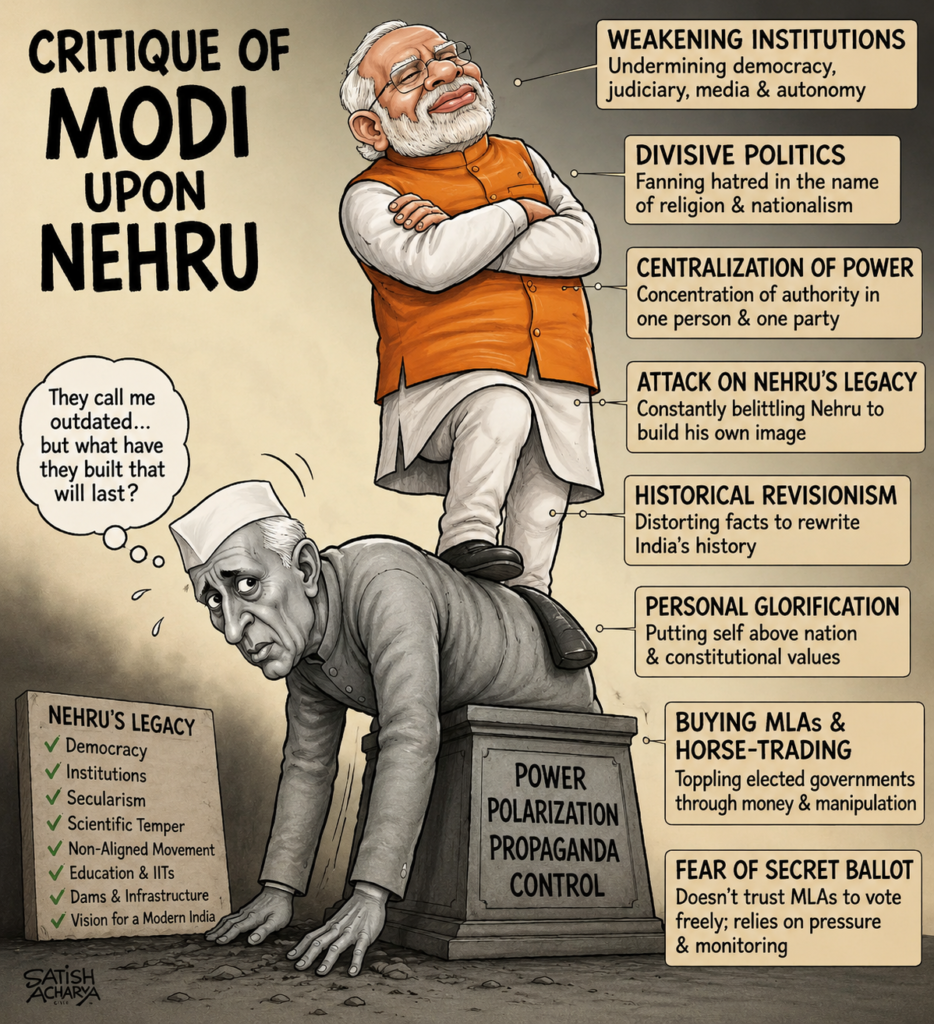
The administration of Prime Minister Narendra Modi faces severe criticism centered on a perceived lack of democratic accountability and transparency. Critics frequently point to a defining record of bypassing traditional, unscripted press conferences, an omission they argue fundamentally undermines democratic oversight by shielding the leadership from independent media scrutiny. This avoidance of open questioning is viewed by opponents not merely as a media strategy but as a deliberate effort to evade direct accountability regarding controversial policies, systemic government failures, and pressing public concerns.
Furthermore, detractors argue that the administration relies heavily on shifting timelines and empty rhetoric, often dismissed as “jumlas”, to deflect from immediate economic challenges. Satirical records highlight a pattern where initial promises—such as requesting 60 months for transformation or 50 days to resolve the fallout of demonetisation—continually give way to vastly extended future targets extending as far as 2047. From the critical perspective, these constantly moving goalposts serve as a political shield to distract citizens from a growing list of unfulfilled mandates and immediate governance issues.
This rhetorical strategy stands in stark contrast to the severe economic and social distress cited by opponents as the true legacy of the tenure. Critics point to a highly strained economy marked by record-high unemployment, a historic devaluation of the rupee, surging commodity and fuel prices, and a widening chasm of income inequality. Beyond economic metrics, the administration is heavily censured for a perceived decline in social cohesion, evidenced by rising communal clashes, caste atrocities, mob lynchings, and recurring institutional failures like rampant educational paper leaks.
The Era of Foundations: Jawaharlal Nehru (1947–1964)
Jawaharlal Nehru’s seventeen years in office were defined by the existential necessity of “nation-building” from a state of post-colonial wreckage. When Nehru took the helm, India was not merely a country in transition; it was a civilisation attempting to forge a modern, democratic identity while coping with the immediate, visceral trauma of Partition.
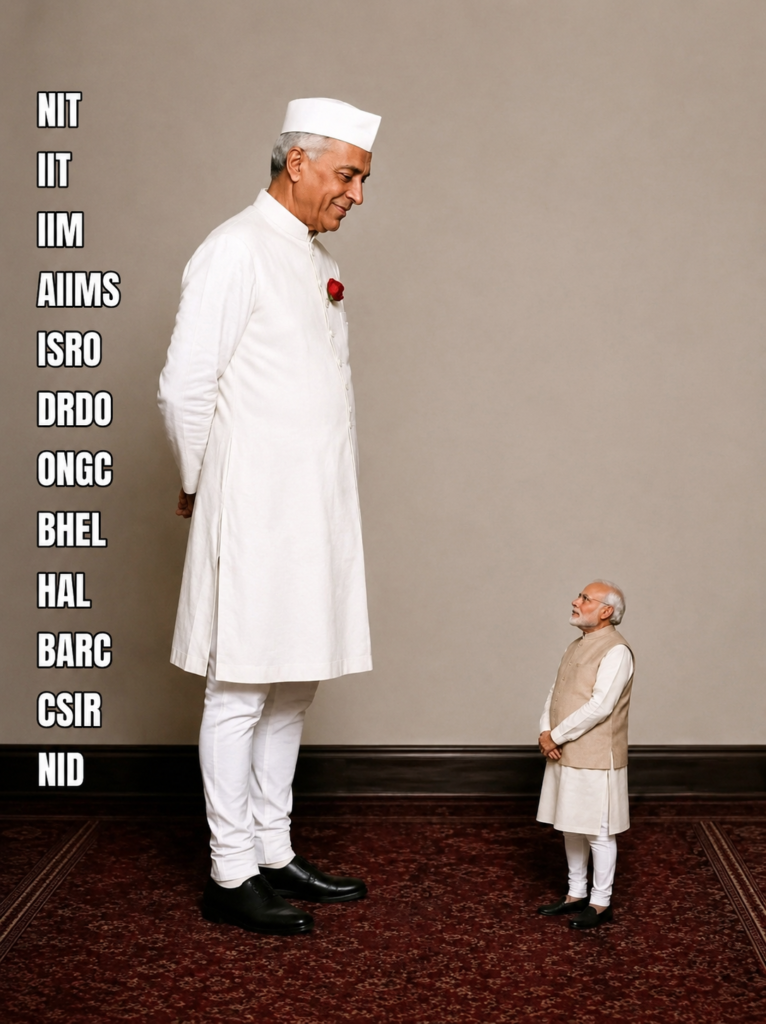
Nehru’s primary historical task was to ensure that the fledgling Indian Republic did not succumb to the fate of many other post-colonial nations that collapsed into military dictatorships or one-party autocracies. He was, above all, a steadfast advocate for parliamentary democracy. By insisting on regular elections, respecting the role of the opposition, and embedding secularism within the constitutional framework, he created the procedural architecture that allowed Indian democracy to survive its volatile infancy.
Nehru viewed science and technology as the primary drivers of India’s escape from poverty. His establishment of the Indian Institutes of Technology (IITs), the All India Institute of Medical Sciences (AIIMS), and various national laboratories reflected his belief that a newly independent nation needed a “scientific temper” to modernise its economy and society. His approach to development was largely state-led, favouring a mixed economy characterised by a strong public sector and centralised planning, intended to provide the basic infrastructure for a country that lacked industrial capital.
On the international stage, Nehru projected an identity for India that was rooted in anti-colonialism and peace. By pioneering the Non-Alignment Movement (NAM) during the height of the Cold War, he sought to maintain India’s strategic autonomy, positioning the nation as a moral voice for developing countries rather than a vassal of the competing superpowers.
The Era of Transformation: Narendra Modi (2014–Present)
If Nehru’s challenge was the creation of a nation, Narendra Modi’s challenge has been the transformation of an established, albeit sometimes sluggish, democratic state. Taking office in 2014, Modi inherited a mature democracy with complex, institutionalised, yet often inefficient systems of governance.
A defining feature of the Modi era is the massive scale of state transformation through digital infrastructure. While previous administrations discussed welfare, the Modi government pioneered a “digital architecture” of delivery. By linking the trinity of Jan Dhan (bank accounts), Aadhaar (identity), and mobile connectivity (JAM), the state radically reduced the distance between the government and the citizen. This direct benefit transfer system aimed to eliminate the “middlemen” who had historically syphoned off welfare resources, fundamentally altering how the Indian state interacts with its most vulnerable citizens.
Modi’s tenure has been marked by a relentless focus on physical infrastructure—highways, railways, airports, and border roads—designed to integrate the Indian economy and provide a strategic edge. This expansion reflects a broader ambition: to transition India from a developing economy to a global powerhouse. His narrative of Viksit Bharat 2047 (a developed India by the centenary of independence) has become the central organising principle of his administration.
Unlike the Nehruvian emphasis on secular neutrality, the current era has seen a concerted effort to place civilisational consciousness at the centre of national self-understanding. Supporters view this as a necessary, long-overdue restoration of India’s cultural heritage and identity. Internationally, this has been matched by a more assertive foreign policy—one that prioritises strategic partnerships, defence preparedness, and a proactive posture in the Global South, moving away from the caution of the past to a position of active global engagement. Historians and political scientists often struggle to compare these two leaders because the environments in which they operated were fundamentally distinct.
The Context of Longevity
Nehru operated in a pre-digital, fragile democracy where the survival of the state itself was the primary objective. His longevity provided the stability necessary for that survival. Modi, in contrast, operates in a hyper-connected, digitised, and highly competitive electoral landscape. His ability to maintain power across three consecutive terms reflects his success in adapting to a 21st century electorate that demands tangible outcomes, rapid welfare delivery, and a confident projection of national strength.
Critics of the current administration often point to the consolidation of executive power, arguing that it threatens the very democratic institutions Nehru established. They emphasise the need for autonomous institutions as a check on authority. Supporters, conversely, argue that for India to overcome decades of policy drift, decisive and centralised leadership was essential to bypass institutional bottlenecks. This highlights a central tension in modern Indian democracy: the balance between effective, high-velocity governance and the protection of pluralistic, decentralised institutional autonomy.
It is premature to render a final verdict on the long-term historical impact of Narendra Modi’s era, just as it is necessary to continue interrogating the long-term consequences of Nehru’s policies. History judges leaders not by their stated intentions but by the structural shifts they leave behind. Nehru left behind a country that believed in its democratic right to exist, a belief that was not guaranteed in 1947. Modi has left behind a country that expects its state to be digitally efficient, globally influential, and culturally self-confident.
The record-breaking tenure of Narendra Modi signifies a shift in the nature of Indian political legitimacy. It shows that in a vibrant democracy, mandates are not static—they are constantly renegotiated. The “Nehruvian” and “Modian” eras represent two different phases of the same national project: one focused on the birth and preservation of the Republic, the other on its global assertion while running with internal crises.
Therefore, the comparison between the two is a testament to the resilience of India’s democratic journey. Both leaders, through vastly different means, responded to the specific anxieties and hopes of their time. The true legacy of this milestone—the fact that an elected leader can secure such prolonged public support—is not the victory of one ideology over another but the confirmation that the Indian voter remains the ultimate arbiter of the nation’s path, continuously shaping the evolution of the state through the ballot box. Future generations will look back at this period not merely to tally the years in office but to understand how these two leaders interpreted the eternal question of what it means to be Indian in an ever-changing world.
Sacred Ballot vs EVMs
One of the criticisms directed at contemporary Indian politics concerns the weakening of the principle of the secret ballot in certain political processes. The secret ballot is widely regarded as one of the foundations of modern democracy because it allows individuals to vote according to their conscience without fear of intimidation, retaliation, or political pressure.
In established democracies such as the United States, Japan, the United Kingdom, Canada, and many European countries, the secrecy of the vote is considered sacred. Election authorities meticulously count ballots one by one, ensuring that every vote remains anonymous while also maintaining transparency in the counting process. The legitimacy of the result derives not only from the counting of votes but also from the assurance that voters made their choices freely and privately.
Critics of electronic voting machines (EVMs) argue that any digital system, no matter how secure, is theoretically vulnerable to manipulation, tampering, or unauthorised access. They contend that unlike paper ballots, which can be physically verified and recounted, electronic systems rely heavily on technology that ordinary citizens cannot independently inspect. This creates concerns about transparency and public trust. Critics further argue that if a voting machine were compromised, it could potentially alter, redirect, or misrecord votes without immediate detection. They often point to international debates over election security and advocate for greater reliance on voter-verifiable paper trails and manual audits. For them, democracy depends not only on conducting fair elections but also on ensuring that citizens have complete confidence in the electoral process. Therefore, they maintain that elections should prioritize maximum transparency, independent verification, and the ability to physically recount votes whenever questions arise regarding the integrity of election results.