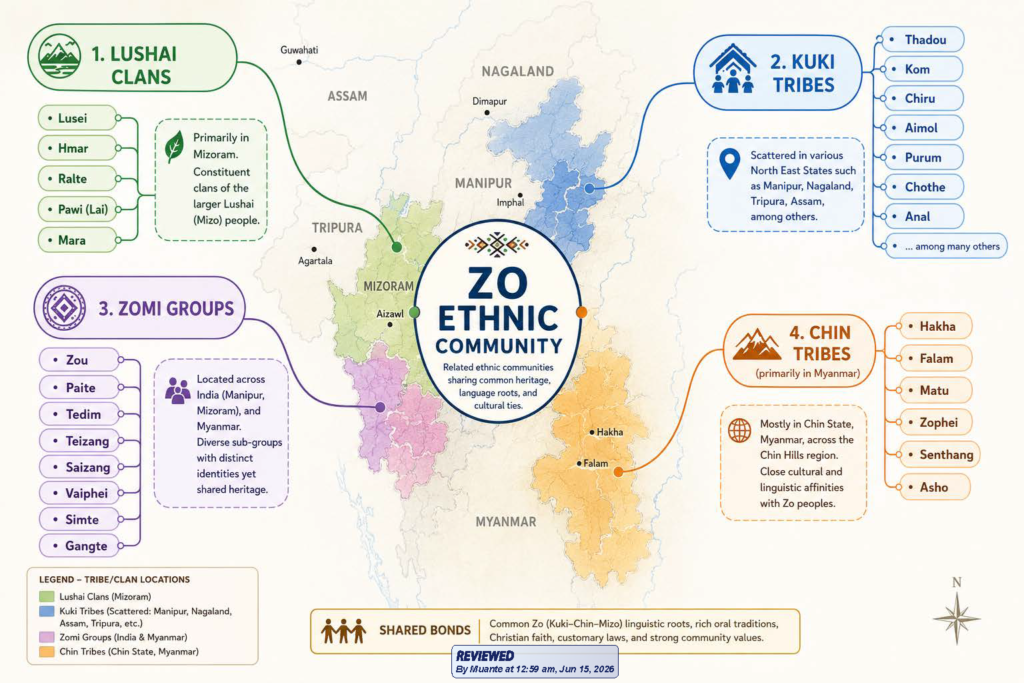

The Zo ethnic community represents a single, historically rooted people bound together by shared ancestry, language, culture, and worldview. Spread across present-day Northeast India and western Myanmar, the Zo people have, over time, come to be known by different names such as Chin-Lushai-Kuki. However, these names do not denote separate origins but rather reflect historical, geographical, and political circumstances. At its core, the Zo community is one people—connected through a common heritage that predates modern boundaries and classifications.
The foundation of Zo unity lies in a shared origin preserved through oral traditions. Across different regions and groups, there exist strikingly similar narratives about ancestry and migration. These stories often point to a common place of origin and a collective past, suggesting that the Zo people emerged as one community before dispersing across the hills of the region. Anthropologists and colonial-era observers also noted these connections. J. Shakespear, in The Lushai Kuki Clans (1912), observed that many of these groups shared “close affinities in language, customs, and traditions”, indicating a common stock. Similarly, G.A. Grierson’s Linguistic Survey of India (1904) grouped these communities within the same linguistic family, reinforcing the idea of shared origin.
Unlike communities defined by rigid historical documentation, the Zo people preserved their past through memory, storytelling, and tradition. These oral histories are not fragmented accounts but interconnected narratives that reinforce the idea of a unified ancestry. The variations found in different versions do not weaken this unity; rather, they reflect the natural evolution of a shared story across time and space. Language stands as one of the strongest pillars of ‘Zo’ unity. The various dialects spoken among Zo communities belong to the same linguistic family and share deep structural and lexical similarities. Whether referred to as Lusei, Paite, Thadou, Tedim, or other such dialects, these forms of speech are mutually connected and often intelligible to varying degrees.
The linguist G.A. Grierson classified these languages under the Tibeto-Burman family, specifically within what is now often termed the Kuki-Chin group. He noted that these भाषाएँ (languages) “form a closely allied group”, further affirming their shared linguistic base. The differences in dialects are not signs of division but expressions of a living language adapting to different environments. They are comparable to branches of the same tree, all rooted in a common linguistic foundation. The development of written forms and standardised languages—especially through the introduction of the Roman script by missionaries like J.H. Lorrain and F.W. Savidge in the late 19th century—further strengthened communication and cultural preservation.
Language, therefore, is not merely a tool of communication but a powerful symbol of unity—linking communities across borders and reinforcing a shared identity. The cultural life of the Zo people reveals a deep and enduring unity. Across regions, one finds common patterns in social customs, festivals, music, and traditional practices. Agricultural cycles, community celebrations, and rites of passage are marked by similar forms of expression, emphasizing collective participation and shared values.
Traditional dances, songs, and folklore carry themes that resonate across Zo communities. Stories of migration, heroism, and community life are widely shared. The well-known concept of Tlawmngaihna (selfless service and community responsibility), often associated with the Mizo, reflects values that are recognizable across the broader Zo world. British administrators and ethnographers repeatedly remarked on these similarities. Lt. Col. J. Shakespear noted that despite differences in names, the people exhibited “remarkable uniformity in social customs and village life”.
Even traditional attire, though varied in design, reflects a shared aesthetic and symbolic language. Patterns, colours, and motifs often carry meanings understood across communities, reinforcing a sense of belonging to a larger whole.
The traditional social organisation of the Zo people further underscores their unity. Clan systems, kinship ties, and communal living are central features across all Zo communities. These structures are built on principles of mutual support, respect, and collective responsibility. Practices such as communal labour and shared resources demonstrate a deeply ingrained sense of togetherness. The well-being of the community is prioritized over individual gain, reflecting a worldview that values harmony and cooperation.
The institution of chieftainship, historically present across Zo areas, also illustrates shared governance traditions. As noted by historians, the village chief was not merely a ruler but a custodian of community welfare, land, and tradition. The widespread adoption of Christianity among Zo communities represents a significant chapter in their shared history. Introduced during the colonial period, Christianity was embraced across regions with remarkable speed. The work of Christian missionaries played a crucial role not only in religious transformation but also in education and literacy. Their work in developing written language systems helped unify communication across communities.
Rather than fragmenting the people, Christianity became a unifying force. As noted by scholars, the church became “the most important social institution” in many Zo societies, fostering cohesion and shared identity. At the same time, elements of traditional belief systems continue to influence cultural practices, creating a synthesis that reflects both continuity and change.
Modern political boundaries have divided the geographical expanse of the Zo people into different administrative regions and nations. These divisions—particularly between India and Myanmar—are products of colonial and post-colonial state formation rather than ethnic separation. The British colonial administration often grouped these communities under broad labels such as “Lushai” [Lusei] or “Kuki-Chin,” sometimes inconsistently. These classifications were administrative conveniences rather than reflections of indigenous identity.
As historian F.K. Lehman (Chit Hlaing) noted, ethnic labels in this region are often “contextual and situational,” shaped by political and administrative processes. However, these distinctions do not alter the underlying reality of shared peoplehood. The names used in different regions—whether Lusei, Kuki or Chin are better understood as contextual labels rather than indicators of distinct origins.
The idea of ‘Zo unity’ is not a modern invention but a reaffirmation of an enduring truth. It recognizes that beneath the diversity of names and local identities lies a single people with a common heritage. Modern Zo intellectuals and leaders have also emphasized this unity. The term “Zo” itself has been used as an inclusive identity to represent all related groups across borders, highlighting a shared consciousness that transcends imposed divisions. Reaffirming Zo unity involves acknowledging shared roots, strengthening cultural ties, and promoting mutual understanding. It requires moving beyond labels that divide and embracing a broader identity that unites.
As the Zo community navigates the challenges of the modern world, the question of identity remains central. Globalization, migration, and technological change are reshaping societies, creating both opportunities and challenges. In this context, the affirmation of unity becomes even more important. A strong sense of shared identity can provide a foundation for cooperation, resilience, and cultural preservation. Scholars have increasingly emphasized the importance of indigenous perspectives in defining identity. For the Zo people, this means reclaiming and reaffirming a shared heritage that predates external classifications.
Conclusion
The Zo ethnic community is, at its core, one people—united by common ancestry, language, culture, and values. Historical records, linguistic studies, and cultural practices all point toward a shared origin and enduring unity. While historical and political factors have introduced different names and classifications, these do not diminish the underlying unity that defines the Zo identity. Understanding the Zo people requires looking beyond surface distinctions and recognizing the deeper connections that bind them together. It is a story of shared origins, collective resilience, and enduring unity.
In a world often marked by division, the Zo community stands as a powerful example of long-standing unity, politically fragmented and at times geographically fragmented, but the Zo people are one with one heritage and one enduring legacy. None of the group can really stand tall with the colonial labels Chin-Lusei-Kuki. They cannot shed their past like a snake discarding its skin. They cannot un-remember the history that binds them.
In essence, the Zo people represent a single ethnic continuum—diverse in expression but unified in identity. Recognizing this unity is essential for understanding their past and shaping their future.