
Lamka: a lovely landscape, where rolling green hills, gentle valleys, and vibrant villages come together in quiet harmony. The land breathes history and belonging, shaped by the lives of its people and the rhythms of nature. Its beauty is not only in its scenery but also in the deep cultural roots and shared memories that make Lamka more than a place—it is a living, enduring home. Names are never neutral. They are not merely labels attached to places; they are repositories of memory, identity, power, and history. In regions marked by layered histories and overlapping communities, naming becomes a site of contestation—an arena where competing narratives struggle for recognition and legitimacy. The case of Lamka, also known as Churachandpur for the Meiteis and Songpi or Tuithaphai to the Thadous (Kuki) and the Hmars, respectively, exemplifies a deep political nature of naming. The phrase “Lamka is Lamka” or, in the words of Pu Dr Tualchin Neihsial “This is Lamka“, is not a simple marker of what is being originally coined; it is a declaration of identity, a resistance against erasure, and a call to restore historical consciousness.
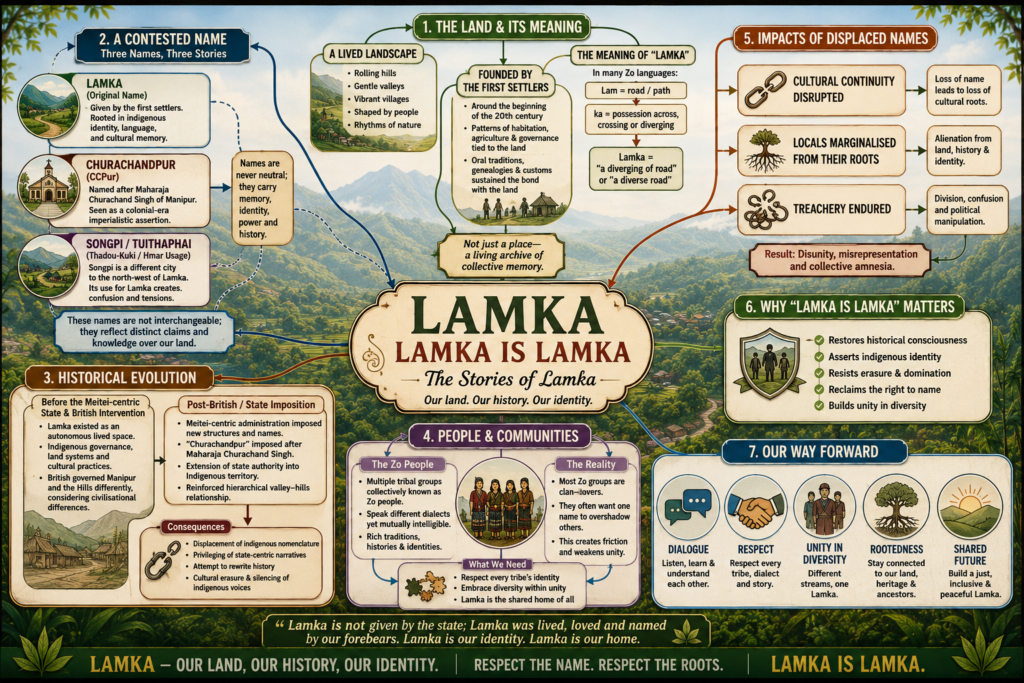
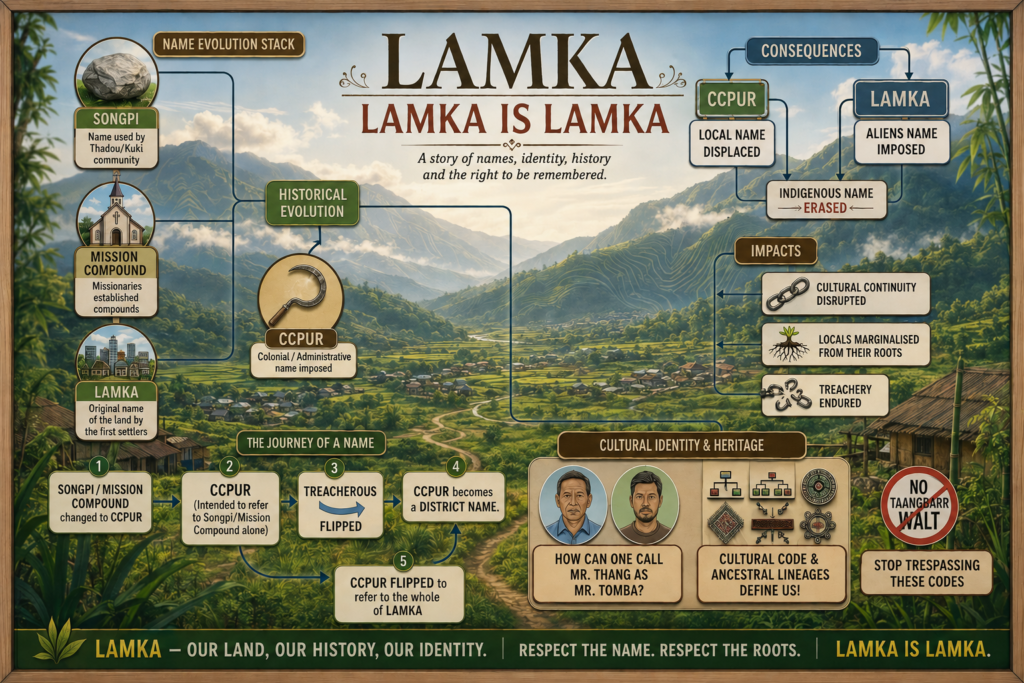
At the heart of this contention surrounding the name Lamka lie several competing names: Lamka, as originally coined by the first settlers; then Churachandpur (often abbreviated as CCPur); and Songpi/Tuithlaphai. Each is associated with different ideological positions shaped by the ‘dialectal communities’ inhabiting the region, who were historically understood under the broader pre-colonial ethnonym ‘Zo people’, now overshadowed by post-colonial institutional structures. These names are not merely linguistic variations; they represent competing claims to identity, history, and legitimacy. At times, the process of naming appears arbitrary—like when “dice are thrown” and “when a coin is flipped”—the native indigenous want to see the flying dice and the flipping coins at the same time. In such moments, communities may come to accept what is given without question as they keep on watching the coin being flipped on their heads, and the flying dice is new; they’ve never seen them. Much like a hungry baby bird that consumes whatever is brought to it, without knowing whether it is an earthworm, larvae, or insects, people may internalise these imposed names without fully understanding their origins, meanings, or implications. This reflects not necessarily consent but mostly rather a colonial rubric shaped by the circumstance of forceful assertion without the will of the indigenous people.
Post the British era, the Meitei-centric government, in their effort to administer and control the region, imposed new structures and categories that often disregarded local realities. One such imposition was the name “Churachandpur”, derived from Maharaja Churachand Singh of Manipur. This renaming was not an innocent administrative act. It represented the extension of state authority into Indigenous territory, effectively subordinating local identities to a centralised political order. By naming the region after a Meitei ruler, the colonial administration reinforced the hierarchical relationship between the valley and the hills—a relationship that continues to shape political dynamics in Manipur. The term “CCPur” or “Churachandpur” thus carries the weight of both colonial and postcolonial forms of structure. It signifies the displacement of indigenous nomenclature and the privileging of state-centric narratives. For many local communities, this name does not resonate with their historical or cultural experiences. Instead, an attempt to rewrite a historical site is more like an attempt to marginalise and silence the indigenous voices; it symbolises a form of cultural erasure, which hungry baby birds would only eat. The state apparatus largely employs “Churachandpur”, which is perceived by local communities as a colonial-era, imperialistic imposition.
The Thadou (who inherited the colonial ethnonym “Kuki” and are perhaps the only community to have carried it forward into the post-colonial era as a contemporary identity) and the Hmar communities have, at times, used the names “Songpi” and “Tuithlaphai” to denote the town of Lamka. Historically, however, these names refer to entirely different settlements. Songpi, literally meaning a big “rock” (likely referencing a prominent landmark encountered by early settlers), is located northwest of Lamka. Meanwhile, Tuithlaphai refers to a small Hmar habitation near the banks of the Tuitha River to the east of, like, the modern-day Saikot. Extending “Songpi” or “Tuithlaphai” to encompass all of Lamka conflates distinct local spaces. While the use of these names for their specific localities is legitimate, contesting the primary name of Lamka with them introduces further political tensions. So, “Churachandpur”, “Tuithlaphai”, and “Songpi”, though emerging from different contexts, reveal competing attempts by different dialectal communities to define and claim the same urban space. Calling the major town centre by the names “Tuithlaphai”, “Churachandpur” or “Songpi” would not align with the intentions of the original settlers, for whom Lamka was both the name and the identity of the place.
But for many indigenous inhabitants, Lamka remained as Lamka as it was originally and rightfully named. These names are not interchangeable; they reflect distinct knowledge and claims over the long-embedded cultural memories. To understand why “Lamka is Lamka” matters, one must examine the historical evolution of these names, the power relations embedded within them, and their broader implications for identity and belonging.
Long before the intervention of the Meitei-centric state Manipur, Lamka existed as a lived landscape shaped by its first settlers. The name “Lamka” is rooted in indigenous linguistic and cultural frameworks. In many Zo languages, ‘Lam’ refers to ‘road’ or ‘path’, while ‘ka’ denotes ‘cross’, ‘crossing’ or ‘diverging’. Thus, “Lamka” may be interpreted as “diverging roads” or simply “diverse roads”, reflecting a deeply relational understanding of place. It is not merely geographic; it is ancestral, cultural, and spiritual. The early settlers of Lamka established patterns of habitation, agriculture, and governance that were intimately tied to the land. Their identity was inseparable from their environment, and the name “Lamka” encapsulated this bond. Oral traditions, genealogies, and customary practices all reinforced the centrality of land as a marker of belonging. In this sense, Lamka was not just a place—it was a living archive of collective memory. It was founded around the beginning of the twentieth century by the native settlers, while the British were governing Manipur as well as the Hills differently from Imphal, considering the civilisational differences of the people.
The region is home to multiple tribal groups who were collectively known, as mentioned earlier, as Zo people, each with its own dialects, which are indeed intelligible to each other (unlike those of the Nagas of those in Manipur and Nagaland), having the traditions and historical memory. However, many Zo ethnic groups maintain strong clan-based affiliations, aspiring toward unity yet ultimately taking their final “sip of their chai” within their own clans. This tendency reflects inherited social patterns shaped by a past marked by inter-village rivalries and raiding traditions. Village-to-village raids were common during their ancestral days. Groups such as the Luseis (Sailous), the Hualngos, or the Pawis, the Guites, the Singsits—and many others—often operated along clan lines when carrying out such raids. This pattern, in one form or another, has carried forward into the present, shaping social behaviour among communities. As a result, groups such as the Thadou, Zou, Vaiphei, Simte, Paite, and others have found it difficult to fully consolidate a broader and more cohesive unity, as their inherited clan-based, episodic traits and tendencies continue to influence their collective alignment.
Even the churches they attend every Sunday often reflect these same tribal alignments. Congregations, in many cases, are organised along clan or tribal lines, reinforcing existing social boundaries rather than transcending them. What is ideally meant to be a unifying spiritual space, thus, at times, mirrors the very divisions present in the wider society. In this way, inherited patterns of affiliation continue to shape not only social and cultural life but also religious spaces, further complicating the pursuit of a broader, collective unity.
This dynamic can be understood as resembling a form of a latent or “hidden” caste-like system, operating subtly within social structures. Much like the ways in which caste continues to manifest in sections of Hindu society today—across institutions such as the medical profession, political spheres, and industrial establishments—these divisions are not always overtly declared, yet they persist through patterns of affiliation, access, and social organisation. In a similar manner, clan-based alignments, though often unspoken, continue to shape interactions and institutional life, reinforcing boundaries that complicate the emergence of a more unified collective identity.
This was further reinforced by postcolonial state formations, which institutionalised tribes as administrative categories and subsequently scheduled them under governmental frameworks, particularly following the Kaka Kalelkar Commission in the 1950s. In such a context, these historically rival, clan-based groups appear to find a certain affirmation in being recognised under distinct names and classifications. The state, in turn, has often been willing to acknowledge and formalise these distinctions, enabling a form of appeasement politics—if not a continuation of the colonial strategy of divide and rule.
As a result, these “baby birds”, so to speak, gradually grow their claws within such a system, continuing to engage in clannish pursuits under newly institutionalised identities. While the earlier raiding practices may no longer persist in their original form, the underlying clannish mentality appears to have been further sharpened and sustained. Today, the Government of Manipur often highlights the recognition of more than thirty tribes within the state as an administrative achievement. Yet, paradoxically, the state itself appears among those seeking recognition as a distinct tribal entity. In doing so, it assumes the role of a claimant within the very framework it has constructed, often at the expense of the existing tribal communities. Their pursuit of recognition as ‘tribal’, rather than resolving tensions, has instead contributed to heightened contestations over identity and belonging, forming part of the broader dynamics that culminated in the ethnic violence witnessed in Manipur in 2023.
Returning to the central discussion—“This is Lamka” or “Lamka is Lamka”—the name itself transcends tribal lines as well as state-imposed assertions. This complexity underscores a central dilemma: how can a name represent a plural society without erasing its internal diversity? For many, the answer lies in returning to “Lamka”—a term that predates these divisions and carries a broader, more inclusive resonance. Against this backdrop, the statement “Lamka is Lamka” emerges as a counter-narrative. It rejects both external impositions and narrow identitarian claims, advocating instead for a name that reflects the shared heritage of the region. It is a call to recognise the historical continuity of Indigenous presence and to resist the fragmentation of identity.
Naming is an exercise of power. It determines how a place is recognised, how its history is recorded, and how its people are identified. In the case of Lamka, the coexistence of multiple names reflects competing claims to authority and belonging. The use of “Churachandpur”, particularly by the state apparatus, illustrates how naming can function as a tool for consolidating political control. By standardising this name in official documents, maps, and institutions, the state effectively legitimises a particular narrative while marginalising others. This process can lead to what scholars such as Spivak describe as “epistemic violence”—the systematic erasure of indigenous knowledge systems. While such assertions may be framed as the so-called administrative convenience, they also raise important questions about inclusivity and representation. However, many of these assertions lack clear jurisprudential grounding and are not sufficiently substantiated by historical records.
The name “Lamka” is deeply embedded in the cultural fabric of the region. It is invoked in songs, stories, and rituals that celebrate the relationship between people and land. Unlike administrative labels, it carries emotional and symbolic weight, serving as a marker of collective identity. No Songpi was ever sung, nor were Tuithlaphai or Churachandpur sung by the native settlers. Cultural continuity is crucial for the survival of indigenous communities. It provides a sense of belonging and a framework for interpreting the world. When names are altered or replaced, this continuity is disrupted. The loss of indigenous nomenclature can lead to a disconnection from ancestral knowledge and traditions. Many of the ancestral remains are good, and they must be preserved at all cost; none shall be discarded but refined. In this context, reclaiming “Lamka” is not merely about semantics; it is about restoring cultural integrity. It is an effort to preserve the intangible heritage that defines the community. By asserting “This is Lamka”, people are reaffirming their connection to their past and asserting their right to define their own identity. No Tomba could be called ‘Thangpu’ because it is not logical; above all, it is not culturally suitable.
The displacement of indigenous names has tangible consequences. It affects how communities are perceived, both internally and externally. When a place is known primarily by a name that does not reflect its indigenous identity, it can lead to misrepresentation and marginalisation. For local inhabitants, this can result in a sense of alienation. They may feel that their history and identity are being overlooked or invalidated. This is particularly significant in regions like Manipur, where ethnic and political tensions are already pronounced. Moreover, the imposition of external names can disrupt social cohesion. It can create divisions between communities, each aligning with different nomenclatures and the identities they represent. This fragmentation undermines the possibility of a unified collective identity. The assertion of “Lamka” seeks to address these issues by providing a common ground. It offers a name that is rooted in shared history rather than imposed hierarchies or exclusive claims.
The phrase “This is Lamka” can also be understood as an act of resistance. It challenges dominant narratives and asserts the legitimacy of indigenous knowledge systems. In doing so, it aligns with broader decolonial movements that seek to reclaim history and identity from colonial and state-centric frameworks. Resistance, in this sense, is not necessarily confrontational; it is restorative. It involves the recovery of suppressed histories and the reassertion of cultural autonomy. By insisting on the use of “Lamka”, communities are resisting the erasure of their identity and affirming their presence. This resistance is particularly important in the context of the postcolonial form of administration, where colonial legacies continue to shape political and social structures. The persistence of names like “Churachandpur” reflects the enduring imposition of power against the native settlers. The imposed name will be challenged with conscious effort to deconstruct and reimagine the narratives that define the region.
Reconciliation requires dialogue and mutual recognition. It involves acknowledging the validity of different perspectives while seeking a shared framework that respects all communities. In this regard, “Lamka” has the potential to serve as a unifying term, provided it is embraced in an inclusive and participatory manner. This process is not easy. It requires confronting historical grievances and addressing power imbalances. However, it is essential for building a cohesive and equitable society. By centring Indigenous knowledge and prioritising inclusivity, it is possible to create a narrative that reflects the complexity of the region.
Conclusion:
The statement “This Lamka” encapsulates a profound truth: that names matter and that the right to name is inseparable from the right to exist. In a region marked by contested histories and identities, Lamka serves as both a reminder and a challenge. It reminds us of the deep connection between people and land and the importance of preserving this relationship. It challenges us to question the narratives that have been imposed upon us and to seek a more inclusive and authentic understanding of identity. Finally, the struggle over naming is not just about words; it is about recognition, dignity, and belonging. By affirming that “This is Lamka”, communities are reclaiming their history, asserting their identity, and envisioning a future where their voices are heard and respected. In this sense, Lamka is more than a name—it is a testament to resilience, a symbol of unity, and a declaration of existence.