
History, Origins, Colonial Construction and Identity Formation
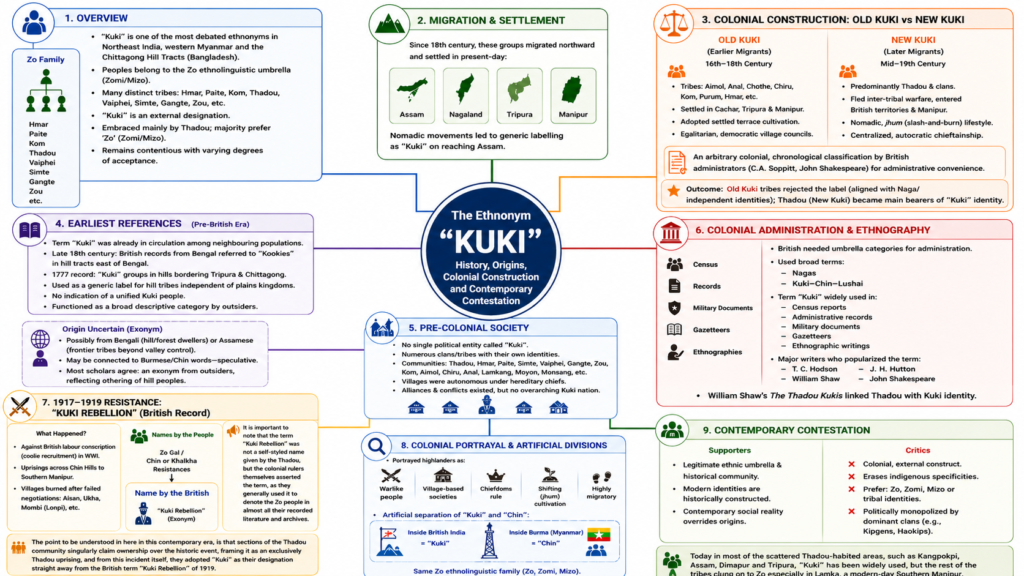
The term “Kuki” is one of the most debated ethnonyms in the history of some of the hill peoples of Northeast India, western Myanmar, and the Chittagong Hill Tracts of present-day Bangladesh. These peoples possess their own genealogical and cultural identity under the broader Zo ethnolinguistic umbrella, represented in various forms such as Zomi and Mizo. Within this larger framework, the communities have distinct tribal identities, including Hmar, Paite, Kom, Thadou, Vaiphei, Simte, Gangte, Zou, etc., whose names are generally associated with dialect, clan, territory, or historical experience. Unlike these indigenous self-designations, “Kuki” is widely understood to have originated as an external designation. Over time, however, the term came to be embraced, particularly by the Thadou, as their identity, which, obviously, overrides the sanctity and the real essence of the historical and genealogical roots, but the majority of the tribal community continued to prefer ‘Zo’ as their identity. The ‘Zo’ here could be either ‘Zomi’ or ‘Mizo’, which will be a discussion for another day. Hence, the term has remained contentious with varying degrees of acceptance among different tribal communities, especially in India’s Northeast in the contemporary period.
As early as the 18th century, these groups migrated northward, eventually settling across present-day Assam, Nagaland, Tripura, and Manipur.
(But this shouldn’t read in the way that the Zo people are landed in the land of Meitei Kings; this assumption is wrong, and it is hugely used in the post-2023 Ethnic violence: to make it clear, the arae occupied by the Meiteis are never disturbed by the Zo people, especially in todays’ Southern Manipur. We keep on using Manipur as it falls under the postcolonial cartographic conundrum as a result of the bias of the British, as in the Chin-Lushia Conference, 1892, at Fort William in Culcutta, so if you are Meiteis who read this, remember that the place where we are inhabiting is not a Meitei territory or not the territory of your titular king, which is 650 sq km or 700 sq miles; you must be thankful to the British).
To fully comprehend this socio-political landscape, one must critically deconstruct how British ethnologists arbitrarily coined the categories of “Old Kuki” and “New Kuki”. Without unpacking these colonial constructs, the contemporary identity crisis cannot be fully understood. Notably, among the tribes originally grouped under the “Old Kuki” designation, none have carried the term forward into the modern era as a self-identity. Historically, the Thadou tribe has been the group most closely associated with and identified by the overarching term “Kuki”. However, this broad classification often obscures their true essence and overlooks their distinct migratory history. Due to their nomadic movements, they were generically branded as “Kuki” upon reaching Assam—a label first formally documented by British colonial officers and political agents on the Northeast Frontier. The etymology of “Kuki” itself remains ambiguous, lacking a definitive native meaning, and is widely believed to have originated from Assamese or Bengali. Understanding the history of the term requires examining its linguistic origins, colonial usage, and subsequent political adoption.
The distinction between the “Old Kuki” and “New Kuki” was an arbitrary, chronological classification introduced by British colonial administrators and ethnologists—most notably C.A. Soppitt and John Shakespear—during the 19th century to categorize successive waves of tribal migrations into the hills of Northeast India from the Chin Hills of Myanmar. The “Old Kukis” (which included tribes such as the Aimol, Anal, Chothe, Chiru, Kom, Purum, and Hmar) were the earlier migrants who had moved northward and settled in regions like Cachar, Tripura, and Manipur by the late 16th to 18th centuries. Because of their prolonged contact with neighboring valley populations, they generally adopted settled terrace cultivation and developed more egalitarian, democratic village council systems.
In contrast, the “New Kukis” (predominantly represented by the Thadou and their various clans) arrived much later, fleeing inter-tribal warfare and pushing into British-administered territories and Manipur by the mid-19th century. Unlike their predecessors, the New Kukis maintained a highly centralized, autocratic chieftainship model and a strongly nomadic, jhum (slash-and-burn) migratory lifestyle. Crucially, this “Old” and “New” taxonomy was a colonial construct designed for administrative convenience rather than an indigenous reality; over time, the two groups diverged sharply, with virtually all the “Old Kuki” tribes subsequently rejecting the Kuki label entirely in favor of Naga or independent identity alignments, leaving the “New Kuki” (Thadou) populace as the primary modern standard-bearers of the Kuki ethnonym.
Ethnic names are rarely neutral labels; they carry dense histories of migration, power, administration, and identity formation. In Northeast India, few ethnonyms have generated as much scholarly and political debate as “Kuki”. Most historians agree that the term was not originally an indigenous self-designation but rather an exonym used by neighbouring valley populations—and later institutionalized by British colonial administrators—to categorise the various hill communities living between the Brahmaputra Valley and the Chin Hills. Through colonial censuses, administrative reports, and ethnographic studies, this external label was systematically codified. This essay examines the historical evolution of the “Kuki” ethnonym, tracing its earliest recorded appearances, its colonial construction, and its eventual adoption and contestation in the modern era.
The earliest known references to the word “Kuki” appear before the British conquest of the region. Historical records indicate that the term was already in circulation among neighbouring populations. One of the earliest documented mentions occurs in the late eighteenth century. British records from Bengal referred to “Kookies” inhabiting the hill tracts east of Bengal. These references suggest that the term was already known among the peoples of the frontier before formal British administration reached the area. Some scholars point to a 1887 record in which British officials mentioned “Kuki” [Zo people] groups inhabiting the hills bordering present-day Tripura and Chittagong. Other references appear in eighteenth- and nineteenth-century travel accounts, where “Kuki” served as a generic label for hill tribes considered independent of the plains kingdoms. Importantly, these early references do not indicate the existence of a unified Kuki people. Instead, the term functioned as a broad descriptive category used by outsiders.
The precise origin of the term remains uncertain. Tracing whether it belongs strictly to the Bengali or Assamese lexicon is secondary to acknowledging its fundamental nature as an external label imposed upon the highly diverse community, yet knitted they are—linguistically or culturally knitted together but divided by the colonial name that they have pursued.
One argument suggests that “Kuki” originated from a Bengali expression referring to hill dwellers or forest inhabitants, while another traces it to Assamese usage in reference to frontier tribes inhabiting regions beyond the effective control of valley kingdoms. Although the precise etymology remains uncertain, both explanations point to a common feature: the term emerged from outside the communities to which it was applied. As an exonym, “Kuki” reflected the classificatory gaze of lowland societies rather than the self-understanding of the hill peoples themselves. In this sense, the term ‘participated in’ refers to a broader process of othering, whereby upland communities were represented as peripheral, wild, or uncivilised in contrast to the supposedly more settled and civilised populations of the plains. The subsequent adoption and institutionalisation of the term by colonial administrators further reinforced these asymmetrical structures of knowledge and power. Some researchers have suggested a possible connection with words used in Burmese or Chin languages to refer to people living in specific regions. Yet these proposals remain speculative.
The most widely accepted explanation among contemporary scholars is that “Kuki” originated as an exonym—that is, a name given by outsiders rather than a self-designation. The term was subsequently adopted and institutionalised through colonial administration. Because of limited historical evidence, no single theory has achieved universal acceptance. Before British rule, the peoples later grouped under the label “Kuki” did not constitute a single political entity. The hill regions stretching from present-day Manipur to the Chin Hills were inhabited by numerous clans and tribes, including:
- Thadou
- Hmar
- Paite
- Simte
- Vaiphei
- Gangte
- Zou
- Kom
- Aimol
- Chiru
- Anal
- Lamkang
- Moyon
- Monsang
These communities generally identified themselves through clan, village, or tribal affiliations rather than through a collective Kuki identity. Political organisation was localised. Villages functioned as autonomous units under hereditary chiefs. Alliances and conflicts existed, but no overarching Kuki nation existed in the pre-colonial period. Consequently, historians generally regard the term “Kuki” during this period as an external category rather than a self-conscious ethnic identity.
The transformation of “Kuki” occurred under British rule. Following the annexation of territories in Northeast India during the nineteenth century, British administrators faced the challenge of governing highly diverse hill populations. To facilitate administration, they categorized communities into broad ethnic groups. The British found it impractical to deal separately with dozens of tribes and clans. As a result, they increasingly used umbrella terms. “Kuki-Chin-Lushai” became one such category. Colonial officers often divided the hill peoples into broad groups: the Nagas, Kuki-Chin-Lushai. These classifications were not based solely on language or culture. Instead, they reflected administrative convenience. As British influence expanded, the term “Kuki” appeared frequently in:
- Census reports
- Administrative records
- Military documents
- Gazetteers
- Ethnographic writings
Colonial usage greatly expanded the scope and significance of the term. Several colonial writers played a major role in popularising the term. Among the most influential ones were T. C. Hodson, J. H. Hutton, William Shaw, and John Shakespeare. These writers described various tribes under the broader category of Kuki. Particularly influential was William Shaw’s book The Thadou Kukis, which helped institutionalise the association between Thadou and Kuki identity. Even within the Thadou-speaking community, the term “Kuki” is far from universally accepted. Disenchanted sections of the populace often distance themselves from the label, critiquing modern “Kuki politics” as being monopolized by dominant, clannish interests—specifically powerful lineages like the Kipgens or Haokips. Furthermore, while the term is frequently treated by proponents as an ancient progenitor of identity, this claim faces profound, unanswered internal contradictions. Grounding one’s heritage strictly in the “Kuki” label inherently limits and obscures true ancestral history; the deep oral cultures, folk songs, and genealogies of these tribes contain no indigenous record of the word. Because the term postdates the actual origins of the communities, relying on “Kuki” as a foundational identity ultimately restricts and distorts the very people it seeks to define.
A poignant example of how colonial nomenclature distorts indigenous history is the pan-tribal uprising of 1917–1919 against British labour conscription during the First World War. Sparked by the brutal enforcement of coolie recruitment for the European front, the upland communities launched armed agitations across a vast theatre stretching from the Chin Hills to Southern Manipur. Locally, these resistances were known by indigenous names such as ‘Zo Gal’ or ‘Chin or Khalkha Resistances’, marked by the burning of defiant villages like Aisan, Ukha, and Mombi (Lonpi or Mualpi?) after failed negotiations. However, because British administrators collectively catalogued all highlanders in this sector under the generic exonym “Kuki”, the entire conflict was recorded officially (by the British) as the “Kuki Rebellion”, and it is from this that the modern-day Kuki identity was conjugated, which was basically in the 1920s or so. The term was NEVER a self-assertation of the Thadous; it was derived from how the British have recorded them.
It is good to note that the term ‘Kuki Rebellion’ was not a self-styled designation coined by the Thadou but rather a colonial construct imposed by British administrators who used “Kuki” as a generic placeholder for the broader Zo populace in their archives. The critical distortion in the contemporary era lies in how sections of the Thadous have singularly monopolised ownership over this pan-tribal uprising, framing the historic event as an exclusively Thadou event. Following the 1917–1919 conflict, they further adopted “Kuki”, a colonial nomenclature, specifically from “Kuki Rebellion”, as their political designation.
The internalization of this external artificial imperial label severed their modern identity from their authentic historical memory. This transition marked the genesis of a profound identity crisis, generating deep-seated confusion across three distinct realms: the cultural, the historical, and the genealogical. By substituting a rich, ancestral heritage with a twentieth-century administrative category, this internalization ultimately obscured the true, organic roots of the people it sought to unify. From there, the modern recognition of Kuki began, but many still stand with their generic Zo essence, meaning Kuki assertion did not transcend the generic Zo. The Thadous, who are mostly in Kangpokpi of Manipur, the Medziphema sub-division of Dimapur, and North Tripura, such as the Jampui and Shakan Hills region and the Cachar Hills in Assam, adopted ‘Kuki’ in full swing, though there was internal disagreement over whether to use ‘Kuki’ or ‘Thadou.’ In Nagaland, the radio program was named the Kuki program, whereas in Manipur it was named the Thadou program. It was within the frontier context of Assam that the term “Kuki” became firmly entrenched in British administrative vocabulary. According to local historical accounts, when British political agents inquired about the identity of the migrating highlanders, local Assamese and Bengali intermediaries—many of whom interacted with these groups near burgeoning frontier industries like the tea estates—referred to them generically as “Kuki.” The British subsequently adopted this external designation raw from the local vernacular, recording it in their official gazetteers and political reports as an established ethnic category.
Colonial ethnographers consistently portrayed the highlanders of the Northeast frontier through a specific, structured lens, framing them as warlike, village-based societies governed by centralized chiefdoms. These populations practiced shifting (jhum) cultivation and were defined by their highly migratory nature across the rugged terrain. While these observations captured essential aspects of upland life, they were deeply colored by colonial assumptions and simplifications that served administrative convenience. One of the most consequential developments of this period was the artificial separation of the “Kuki” and “Chin” designations. Despite sharing profound linguistic, cultural, and ancestral affinities, these communities were divided strictly along political boundaries drawn by imperial mapmakers. Highlighting this arbitrary line, communities falling inside British India were systematically labeled “Kuki,” while their close kin across the border in Burma (Myanmar) were designated as “Chin.” This administrative fracturing laid the groundwork for separate political identities to emerge, despite the fact that modern scholars recognize these groups—alongside the Mizo and Zomi—as branches of the same overarching Zo ethnolinguistic family.
By far, communities that historically identified primarily by their distinct tribal markers—such as the Paite, Simte, Vaiphei, Gangte, and others—did not really accept ‘Kuki,’ except the Thadou speakers and the government; and even the rest of the world used it to refer to the Zo people. But the term remains deeply contested and politically polarized in the contemporary period. While some sections embrace it as a legitimate ethnic umbrella and an authentic historical community, others strongly reject it, preferring alternative ethnonyms like Zo, Zomi, Mizo, or their specific tribal identities. Critics argue that the colonial origins of “Kuki” render it an artificial, external construct that erases indigenous specificities, while proponents counter that almost all modern ethnic identities are forged through similar historical processes and that contemporary social reality overrides etymological origins. Today, particularly in states like Manipur, Assam, and Tripura, the term functions as a powerful socio-political force, even as parallel alignments like Zo, Zomi, and Mizo continue to actively shape regional discourse, illustrating the fluid and fiercely debated nature of ethnic formation in Northeast India.
This intricate history demonstrates how ethnic identities are fundamentally formed through continuous interactions between local communities, neighboring valley societies, imperial administrations, and modern political movements. Historical evidence confirms that “Kuki” began strictly as an external label rather than an indigenous self-designation, appearing in eighteenth-century frontier records before gaining massive prominence under British rule. Institutionalized through administrative classification and ethnographic writing, it became a sweeping category encompassing numerous independent tribes inhabiting the hill regions. Events such as the 1917–1919 resistance and colonial census operations further consolidated the label.
Finally, the term “Kuki” occupies a highly complex and fragmented position in the modern landscape. For many, it represents a deeply meaningful ethnic and political shield; for others, alternative identities such as Zo, Zomi, Mizo, or specific clan affiliations remain far more vital and historically accurate. The continuing debates surrounding the term reflect much broader, universal questions about ethnicity, the lasting legacy of colonial knowledge, and the struggle for political representation. In the end, the friction between its external, colonial origins and its contemporary political utility underscores a profound truth about Northeast India: identity is not a static historical relic but an ongoing negotiation between how a people are seen by the world and how they choose to define themselves.
“Kuki” is an external ethnonym—it illustrates how identities are named, categorised, contested, and ultimately reimagined over time.