

The Intellectual Light of the Humanities: A Reflection on Jordan B. Peterson
I recently purchased Professor Jordan B. Peterson’s book after watching his presentation on YouTube, and it has deservingly taken a top spot on my reading list. Anticipating it to be an incredibly profound read, I cannot help but reflect on the broader impact of his work. To put it plainly, having a thinker like Professor Peterson on this earth feels like a genuine blessing to humanity. I find myself listening to his lecture series, interviews, and public talks almost non-stop. He stands out as a remarkably authentic figure in a superficial world precisely because he refuses to be a simple “yes man.” Instead, he analyzes complex issues with a depth that routinely defies expectations.
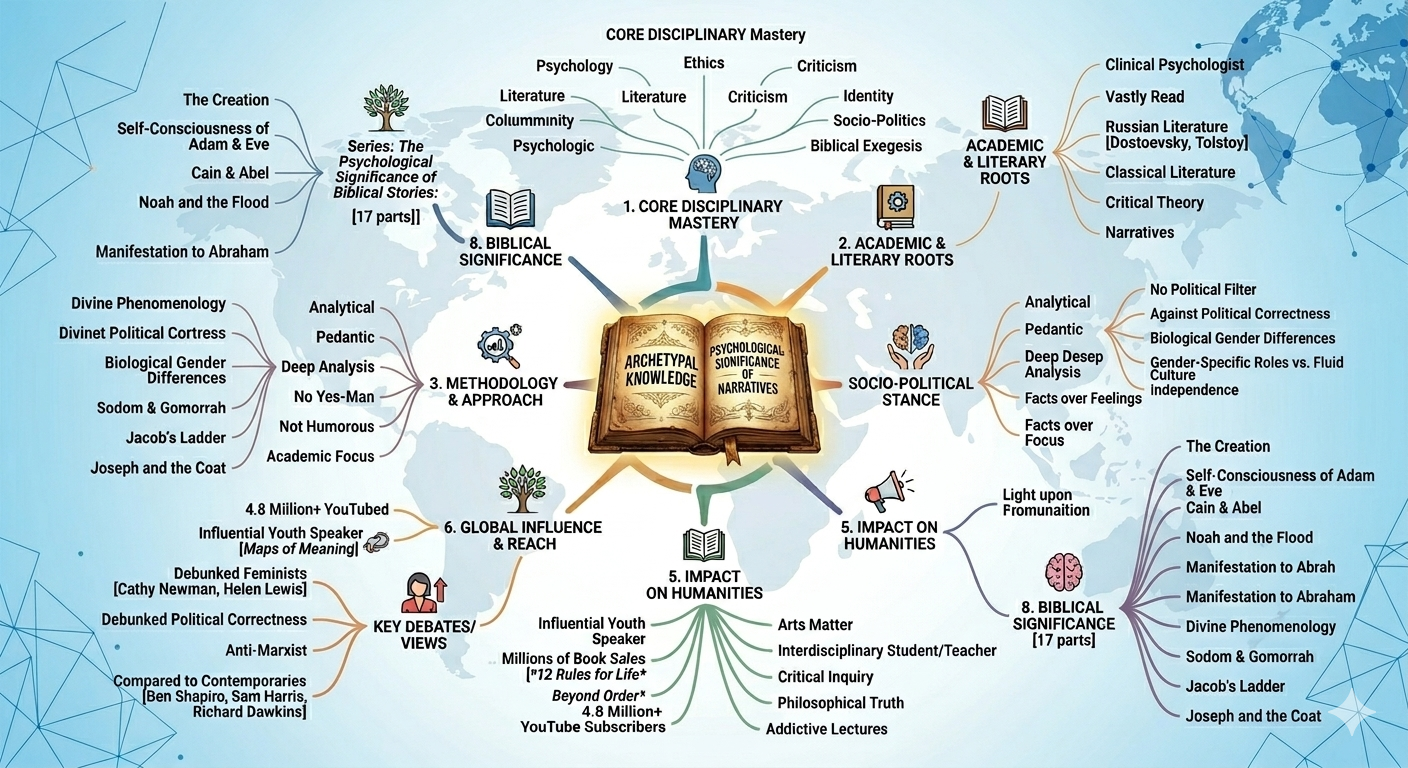
What makes Professor Peterson so uniquely compelling—especially to students and scholars—is his astonishingly broad knowledge across the entire spectrum of the humanities. His insights seamlessly bridge clinical psychology, classical literature, critical theory, socio-politics, biblical exegesis, and the critiques of postmodernism. He has shed a brilliant, much-needed light on the value of humanistic study.
Interestingly, his work invites fascinating questions about his own underlying worldview. Given his deep fascination with social systems and his highly cerebral approach to faith, one might occasionally wonder if he harbors a subtle inclination toward a sort of systemic socialism, or if he leans somewhat atheistic in his personal convictions. Yet, his grasp of these domains is undeniably masterful. He is clearly a voracious reader who has deeply internalized everything from Western philosophy to the masterpieces of Russian literature, particularly the profound psychological depths of Dostoevsky and Tolstoy.
Furthermore, he is deeply acquainted with the intricate art of modern identity politics and the nuances of contemporary feminism. He famously debunked the ideological frameworks of interviewers like Cathy Newman and Helen Lewis by steadfastly asserting the biological and psychological differences between men and women. His assertions on gender roles and modern socio-political movements often run entirely counter to standard institutional political correctness, yet they consistently carry a powerful, empirically grounded validity. As an independent, highly educated, and outspoken intellectual, he exercises his knowledge and his rights with rare courage. There is an immense wealth of perspective, wisdom, and actionable life advice to be extracted from his library of work.
My encounter with Professor Peterson’s work began during my Master’s degree—a formative time when he essentially became my ultimate online lecturer. For any student of literature, it is easy to become addicted to his content. Throughout my academic journey, I frequently utilized YouTube to supplement my curriculum with lectures from prestigious institutions like Yale, Stanford, and Harvard. However, while exploring Cultural Studies—a major domain of my academic interest—I crossed paths with Professor Peterson’s lectures on Modernism and Gender Studies.
In the modern academic landscape, it is almost impossible for a student of literature to avoid his work. His analysis of literary theory and criticism—whether decoding feminism, exploring psychoanalysis, or deconstructing social structures—is more than enough to captivate anyone drawn to the liberal arts. He possesses a masterful understanding of narrative architecture. Any interdisciplinary student or educator will inevitably cross paths with his lectures because he consistently makes profound sense, frequently enlightening the deeply embedded thoughts we struggle to articulate ourselves. His stances on the specific, evolutionary roles of males and females are razor-sharp, embodying the famous mantra popularized by his contemporary Ben Shapiro: “Facts don’t care about your feelings.” At a time when modern society seems to exclusively cherish technological advancement and machine learning, Professor Peterson makes the arts and humanities feel vital, vibrant, and deeply interesting again. Arts and humanities matter. We owe a debt of gratitude to the loose coalition of modern Western thinkers and public intellectuals—including figures like Jordan Peterson, Ben Shapiro, Sam Harris, and Richard Dawkins—who, despite their vast ideological differences, have collectively swayed the global cultural conversation back toward the rigorous pursuit of knowledge, truth, and philosophy.
Key Takeaways from the JBP Phenomenon:
- Academic Brilliance as Influence: He is an extraordinarily gifted orator who influences millions of young people globally by utilizing a rigorous, academic approach rather than relying on cheap rhetoric.
- Interdisciplinary Mastery: His expertise spans far beyond clinical psychology, rooted deeply in classical literature, ethics, and identity.
- Unfiltered Courage: He operates with absolutely no political filter or proclivity for institutional political correctness.
- The Reality of Biology: He advocates for the reality of distinct, gender-specific roles while acknowledging that culture remains fluid.
- The Style of a Truth-Teller: He rarely relies on humor, dry metaphors, or trivial entertainment; his delivery is straight to the point, intense, and intellectually demanding.
- Massive Cultural Impact: With over 4.8 million YouTube subscribers and books like 12 Rules for Life, Maps of Meaning, and Beyond Order selling millions of copies worldwide, his ideas are being consumed and integrated by a massive global audience.
The Psychological Significance of the Biblical Stories
I recently accomplished the feat of listening to his entire 17-part lecture series, The Psychological Significance of Biblical Stories: Genesis. To state that these lectures were “juicy” and precise would be an understatement. Professor Peterson’s pedantic, well-versed approach transformed ancient text into a gripping psychological roadmap.
As a renowned clinical psychologist, his framework was not dogmatic, but rather analytical, treating the Abrahamic faith and the gentry of Genesis as foundational archetypes of the human psyche. The series brilliantly unpacked:
- The Creation,
- The Idea of God,
- Self-Consciousness of Adam & Eve,
- The Manifestation of God to Abraham,
- The Hostile Brothers (of Cain & Abel),
- Noah and the Flood,
- Moses and Chaos,
- Jacob’s Ladder,
- Divine Phenomenology and the Babel Tower,
- Sodom & Gomorrah,
- The Great Sacrifice of Abraham,
- Joseph and the Coat/Joseph, the Dreamer.
- The Story of so-and-so in Genesis,
So, Professor Peterson reminds us that a nation, much like a tree, requires deep roots to survive. Without education, profound psychological policy, and moral accountability, a society cannot experience true development. Bribery, superficiality, and ideological faking will never move humanity forward. Through his books and lectures, Jordan Peterson provides the modern world with the intellectual nutrients required to keep those vital roots alive.